
As Cuba’s communist rulers scramble to fix a collapsing system, they are quietly admitting that socialism has failed—but only after driving their people into deep crisis.
Story Snapshot
- Cuba’s president now says the island “cannot continue on its current path” and needs urgent economic change.
- Havana is copying parts of China and Vietnam, allowing more private activity while clinging to one-party communist rule.
- Key reforms give towns and state companies more freedom, but critics call them limited, late, and aimed at saving the regime.
- Experts say years of government mismanagement, not just U.S. sanctions, helped create Cuba’s deep economic collapse.
Communist Havana Admits Its Economic Model Is Failing
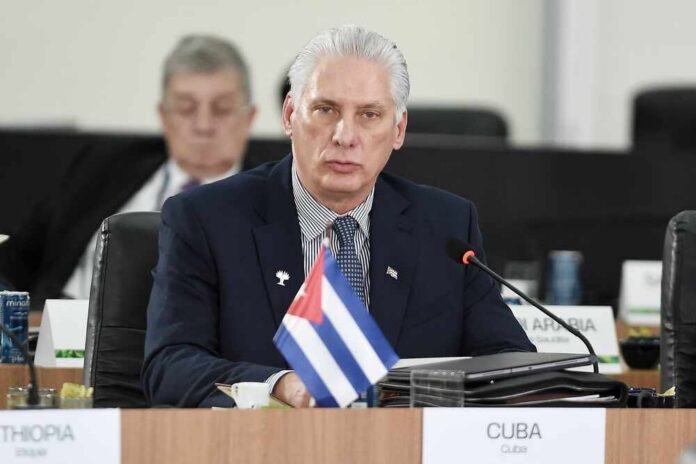
Cuban President Miguel Díaz-Canel has now gone on state television and told party leaders that Cuba’s communist system needs “urgent and essential changes” to survive a severe economic crisis.[5] He admitted that the situation is so bad that the country “cannot continue on its current path,” a rare confession from a regime that for decades blamed almost everything on the United States.[2] He said the crisis has been worsened by a United States oil embargo, but he also conceded that internal changes are now unavoidable.[5]
The Cuban leader described a new “Economic and Social Program for 2026,” a package of structural reforms meant to overhaul how the island’s state-run economy works.[6] He told officials they must move “immediately” to carry out key changes in the economic and social model, after years of shortages, blackouts, and shrinking production.[2] This marks his most direct public signal that the old socialist framework is broken and that simple “resistance” to outside pressure is no longer enough to keep the country afloat.[4]
What the New Reforms Claim to Change on the Island
The reform plan says Cuban municipalities will now have “full autonomy” to import and export, handle foreign investment, and run local production without higher-level state intermediaries.[6] Díaz-Canel said towns could manage income in foreign currency and work directly with companies and Cubans living abroad, which would be a big shift from tight central control.[6] State enterprises are supposed to operate “without interference” in their management, choose their own suppliers and clients, and keep more foreign currency earnings.[6]
New measures also promise to open the door wider to private and foreign money, including Cuban exiles who have long been shut out or limited.[4] Reports say Cubans on the island and abroad will be allowed to invest on “equal terms” with foreign investors, something Havana previously resisted.[4] Private businesses are expected to gain new rights to import fuel and operate in areas once controlled by state monopolies, a notable change in a system where the government has dominated most sectors for decades.[3]
Cuts to the Bureaucracy and Talk of Copying Other Communist Models
To pay for future wage changes and try to tame budget problems, the Cuban government says it will sharply cut ministries and bureaucratic posts.[1] One report describes a plan to bring the number of ministries down from twenty-seven to around twenty or twenty-one, along with other steps to trim public payrolls.[4] The emergency agenda also includes macroeconomic stabilization, recovery of agriculture, better cost control, and steps to soften the social impact of these changes.[4]
Díaz-Canel has openly said that Cuba has studied the economic paths of China and Vietnam as it looks for ways to “liberalize” parts of its economy while keeping communist one-party rule.[4][5] He argued that these reforms aim to “generate economic prosperity and distribute it fairly,” framing the shift as a way to save socialism, not abandon it.[5] State media even boasted that the government used artificial intelligence to evaluate proposals, a striking contrast with the daily reality of blackouts and food lines.[4]
Why Many Analysts Say the Reforms Are Too Little, Too Late
Independent experts warn that Cuba’s crisis did not begin with the latest oil blockade, but comes from years of structural stagnation, falling public services, and rising inequality inside the island.[6] One detailed analysis notes that earlier reforms under Díaz-Canel raised hopes but “have so far not brought substantial progress,” and have sometimes backfired by stoking inflation and hurting key sectors like sugar production.[6] That track record makes many doubt that this new package will be enough to fix deep underlying problems.
Outside observers and Cuban exiles are also skeptical because the government has offered few hard details or timelines for the reforms, especially on how quickly changes will occur on the ground.[2] Some South Florida experts and residents describe the measures as “too little, too late” and see them as an attempt to “buy time” and calm public anger without giving up real political control.[14] At the same time, Díaz-Canel himself has admitted that protesters in July 2021 were “legitimately dissatisfied,” which shows how wide and genuine the frustration has become.[8]
What This Crisis Reveals About Socialism, Freedom, and U.S. Policy
Reports from Europe and academic studies stress that the current collapse comes from both external pressure, like United States sanctions, and years of government mismanagement, including failure to build reliable energy sources or allow a healthy private sector.[13][16] The United States embargo is real, but analysts point out that the Cuban state kept tight control even when it expanded small private businesses and then pulled back again when it feared losing political grip.[9] That back-and-forth has left the island stuck between half-hearted market steps and rigid one-party rule.
Cuba’s leaders now want more private money and local freedom without giving up their monopoly on power, a pattern seen in other authoritarian “reform” cases.[18] For American conservatives, the lesson is clear: central planning, speech limits, and hostility to free enterprise always end in shortages, anger, and escape to freer shores. As Washington weighs how to respond, the priority remains defending American security, keeping pressure on a repressive regime, and standing with the Cuban people’s long struggle for real liberty and self-government.
Sources:
[1] Web – Cuba leader admits ‘urgent changes’ needed to overcome crisis
[2] Web – Díaz-Canel announces reforms to liberalize Cuba’s economy
[3] Web – Cuba’s president announces economic reforms to spur investment …
[4] YouTube – Cuba: Díaz-Canel announces economic reforms to attract investment
[5] Web – Cuba’s leader announces economic reform amid U.S. pressure
[6] Web – Cuban President Miguel Diaz-Canel announces a sweeping reform …
[8] Web – LEGAL REFORM TARGETING THE CUBAN ECONOMY LED BY …
[9] Web – Cuba July 11 Protests – LeoGrande – American University
[13] Web – United States embargo against Cuba – Wikipedia
[14] YouTube – What Is Driving Cuba’s Economic Crisis? Economist Emily Morris …
[16] Web – Cuba is facing a deep economic crisis, with officials blaming U.S. …
[18] Web – US Expands Embargo on Cuba as Secondary Sanctions Pose New …