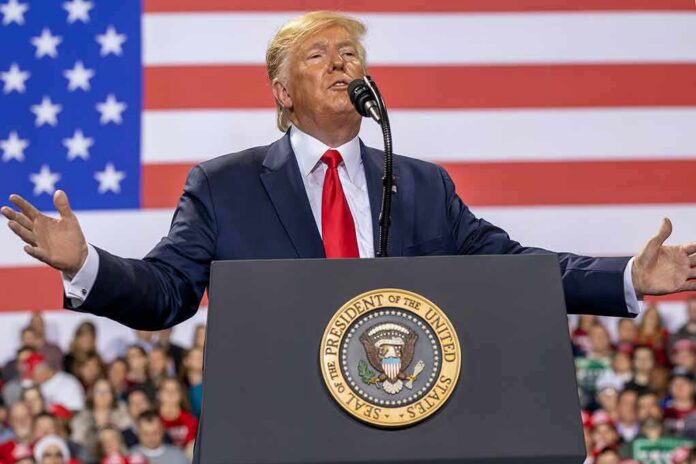
At a surprise White House briefing, President Trump declared “There will be no amnesty,” and said his enforcement policy “hasn’t changed.”
Story Snapshot
- Trump told reporters there will be no amnesty and reaffirmed current deportation policy.
- He said enforcement will keep focusing on violent offenders, “the worst of the worst”.
- Homeland Security Secretary Markwayne Mullin echoed: “no amnesty,” no policy change.
- Media highlighted prior remarks about possible talks on long-term residents, fueling debate.
Trump’s On-Camera Rejection of Amnesty
President Trump faced reporters on November 9, 2026, and answered a direct question: “There won’t be amnesty.” He added that his deportation policy “hasn’t changed,” signaling steady enforcement. That short exchange set the tone. It closed the door on speculation that the White House was moving toward legal status for people who crossed illegally. It also told border agents and the public that the rules they have followed remain in place.
Trump then framed priorities around public safety. He said the administration would keep removing the “worst of the worst,” and named murderers as a focus. The line fits a simple message: protect families first, then handle the rest. That message matters to communities hurt by drugs, gangs, and repeat offenders. It also answers critics who claim enforcement is random or cruel. Trump argued it is targeted at those who pose real danger.
DHS Alignment: Mullin Says Policy “Isn’t Going to Change”
Homeland Security Secretary Markwayne Mullin backed the president’s stance. He said there would be “no amnesty,” and the enforcement approach “isn’t going to change.” That alignment between the White House and the Department of Homeland Security matters. It signals to field offices that policy remains firm. It also shows the administration understands the lesson from past failures: strong laws mean little if leaders blink when pressure comes from lobbyists or media spin.
Mullin also noted that any future immigration reform would run through Congress. He referenced debates over people who came here as children. He said lawmakers, not the executive branch, would have to decide any legal status in that space. That point keeps clear lines. The Constitution gives Congress the power to write laws. The executive branch enforces them. By stressing “no amnesty” while pointing to Congress for reforms, the administration grounded its stance in the rule of law.
The Media Whiplash: Parsing the 60 Minutes Backdrop
News outlets fixated on Trump’s recent 60 Minutes comments. In that interview, he said deportations may have been “too tough” and mused about a deal for long-term residents. Those reports fueled claims of a soft turn. The press conference pushed back on that view, yet the tension remains in coverage. Some reports frame the no-amnesty line as a walk-back; others as a firm reset. The White House has not released new written rules that define “amnesty” in legal terms.
After saying deportation policy was too tough, Trump now says it’s ‘very strong,’ rejects ‘amnesty’ https://t.co/SfcUsGUBZE
— Diana Barahona (true name) (@dlbarahona) November 10, 2026
That lack of a formal definition gives critics room to label any relief as “amnesty.” It also invites confusion between talks and policy. A talk is not a law. A quote is not an order. The November 9 message, however, was plain: no amnesty, steady enforcement, criminals first. Until Congress passes a bill or the administration issues written guidance, those words set expectations for agents, courts, and communities along the border and beyond.
Sources:
us.cnn.com, theepochtimes.com, cnn.com, dailysignal.com, thestatesman.com, yahoo.com