

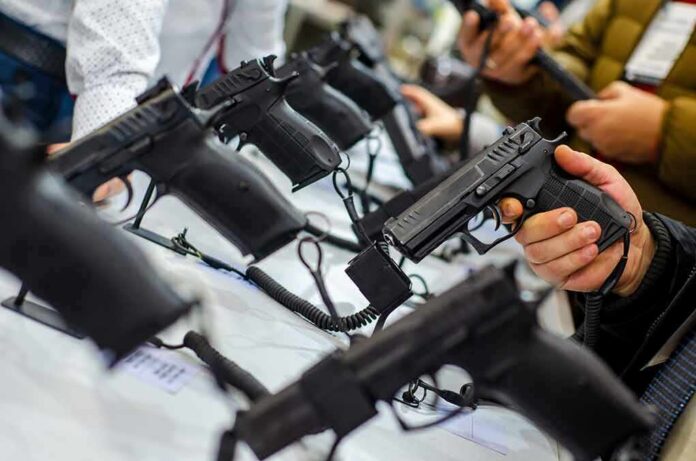
A federal appeals court struck down the interstate handgun sales ban, delivering a major win for the Second Amendment.
Story Highlights
- The Fifth Circuit reversed the district court and ruled for the plaintiffs in Elite Precision Customs v. ATF.
- The court held that buying a handgun is part of “keeping and bearing arms,” so the ban violates the Constitution.
- The ruling targets 18 U.S.C. §§ 922(a)(3), 922(a)(5), and 922(b)(3), which blocked direct out-of-state handgun purchases.
- The government’s history claims failed under the Supreme Court’s Bruen test, the majority said.
Fifth Circuit Says the Ban Violates the Second Amendment’s Text
The United States Court of Appeals for the Fifth Circuit held that federal limits on buying handguns across state lines burden conduct the Second Amendment protects. The court said the right to keep and bear arms includes acquiring firearms. The panel reversed the district court and rendered judgment for the challengers in Elite Precision Customs L.L.C. v. Bureau of Alcohol, Tobacco, Firearms and Explosives, decided September 18, 2026. The majority described the ban as conflicting with the Amendment’s plain text, rejecting narrower views of the right.
The ruling focuses on three parts of federal law: 18 United States Code sections 922(a)(3), 922(a)(5), and 922(b)(3). Together, these provisions barred a law-abiding buyer from completing a direct handgun purchase from an out-of-state dealer. Buyers could only route the gun through a home-state dealer, adding time, paperwork, and charges. The court said these burdens hit the core right because acquisition is necessary to keep arms, not a side issue outside the Constitution’s protection.
Government’s Workaround and History Arguments Come Up Short
The government argued that the ban could be bypassed by shipping a handgun dealer-to-dealer, with the buyer finishing the sale at home. The court quoted the position and noted that the workaround “invariably” adds a fee beyond the gun’s price, placing power in third parties and raising costs. Plaintiffs described transfer fees and delays that made simple, lawful purchases harder than needed. The government’s point that a gun can still be obtained did not save the ban under the current test.
Under the Supreme Court’s New York State Rifle & Pistol Association v. Bruen framework, the government must show a close match with the nation’s historical tradition of gun regulation. The Fifth Circuit majority said the analogues offered—such as wartime export rules or trade limits—did not match a blanket ban on direct interstate handgun sales to nonresidents. The court found the fit too loose, so the modern ban failed the history test and could not stand.
Panel Split, Practical Effects, and What Comes Next
The three-judge panel split 2–1. Judge Jerry Smith wrote the majority, and Judge Kurt Engelhardt joined. Judge Catharina Haynes dissented, according to coverage of the opinion and vote. The decision reverses the lower court, which had sided with the government. The Fifth Circuit’s ruling now controls in its region unless changed by further review. Other circuits have handled similar issues differently, setting up possible future conflict.
For gun owners, the decision removes a federal barrier that forced dealer-to-dealer transfers, extra fees, and added wait times. The case record highlighted buyers who faced $30 to $40 transfer fees and delays when trying to follow the law. The court treated those costs as a real burden on a constitutional right, not a small inconvenience. The ruling is a clear signal: the Second Amendment protects the ability to buy a handgun, not only to own one afterward.
Why This Matters for Constitutional Rights and Everyday Buyers
This win protects more than a transaction. It protects a right that must work in real life. A right that is too costly or too slow can fade for regular citizens. The court’s ruling rejects a system that priced freedom with middleman fees and red tape. It also checks federal overreach that has stood since the late 1960s. The message is simple and strong: if the government wants a limit, it must match our history and respect the text of the Constitution.
Sources:
reason.com, nysafeinc.com, legalinsurrection.com, ca5.uscourts.gov, redstate.com