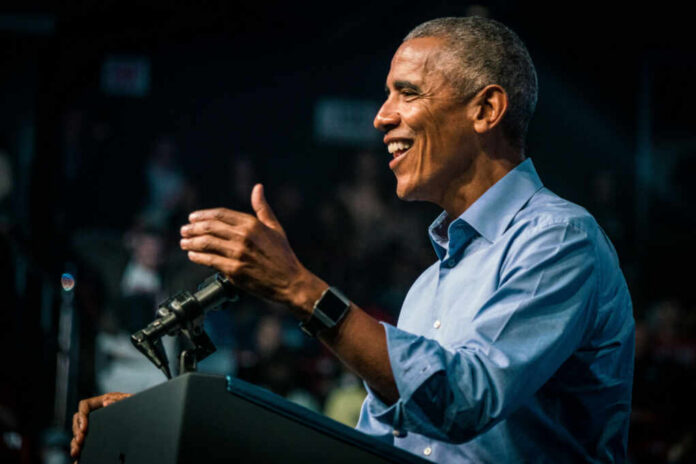
Barack Obama defies the quiet retirement tradition of ex-presidents, wielding shadow influence over Democratic politics nearly a decade after leaving office.
Story Snapshot
- Obama, at age 65 in 2026, remains hyper-active through his Foundation, endorsements, and media deals, unlike Bush’s painting or Carter’s humanitarian work.
- Critics label him a “shadow president” for intervening in primaries, fundraising $500M+ for Democrats, and critiquing successors.
- His persistence stems from a fragile legacy—over 1,000 Democratic seats lost during his term—driving post-presidency defense of policies like ACA and DACA.
- Recent 2026 activities include midterm fundraisers and voting rights critiques, redefining ex-presidential norms amid polarized politics.
Obama’s Post-Presidency Trajectory
Obama exited the White House on January 20, 2017, but immediately launched the Obama Foundation in Chicago and Higher Ground Productions with a Netflix deal. He spoke at DNC events and endorsed candidates in 2017-2018. By 2020, Obama backed Biden and campaigned virtually during COVID. In 2022, he publicly and privately criticized Biden’s administration on inflation. His 2024 involvement aided Biden-Harris efforts and extended to post-election transition advice for Harris. This timeline reveals calculated continuity.
Foundation and Media Empire Fuel Influence
The Obama Foundation, endowed with $1.8 billion, trains leaders and nears full operation of the Obama Presidential Center in 2026, with ribbon-cutting rumors for June. It partners with the DNC and universities, though conservatives decry it as a vanity project. Netflix productions and podcasts like “Renegades” with Bruce Springsteen amplify his voice. Book deals exceeding $70 million and a $100 million net worth sustain his platform. Social media reach—65 million X followers—sets him apart from predecessors.
Democratic Party Reliance and GOP Backlash
Democrats leverage Obama’s star power, raising over $200 million from 2020-2024 and $500 million total since 2017, per FEC data. He acts as kingmaker, endorsing Harris amid 2024 primary rumors and advising transitions. DNC Chair Jaime Harrison taps his influence for morale and funds. Republicans, including Trump and McConnell, brand him “deep state” interference, fueling attack ads like the 2024 “third term” narrative. This dynamic polarizes discourse and mobilizes GOP bases.
Conservative commentators like Victor Davis Hanson argue Obama’s meddling erodes democratic transitions and ex-president norms, a view aligning with common sense expectations of graceful retirement. Facts support this: unprecedented scale via digital tools contrasts with Reagan’s occasional speeches or Clinton’s endorsements.
Why Won't Barack Obama Go Away? – PJ Media https://t.co/WUiH18ifdD
— Bill (@Just_A_Bill_) May 9, 2026
Recent Activities and Legacy Defense
As of May 2026, Obama hosts virtual fundraisers for midterms and posted on X in April critiquing GOP voting rights stances. A March 2026 podcast declared, “Legacy isn’t static—it’s defended daily,” backing filibuster reform. January 2025 saw post-Harris transition advice; October 2025 featured a DNC speech for 2026 candidates; April 2026 hosted a Foundation summit. No 2028 run, but he mentors emerging Democrats. A 2025 book “Onward” topped charts.
Impacts and Expert Views
Short-term, Obama boosts Democratic turnout and morale but invites “Obama fatigue.” Long-term, he shapes leadership pipelines and invests billions in Chicago’s economy. Pew polls show 52-55% favorability in 2026. Historians at Brookings note his policymaking strength but party-building failures—over 1,000 state seats lost—prompting this activism. JFK Library forums highlight GOP obstruction limits. Conservatives see dynasty-building; progressives, essential resistance. His youth and resources enable redefinition of ex-presidency.
Sources:
Brookings.edu: Legacy fragility, seat losses.
JFLLibrary.org: Presidency assessment.