
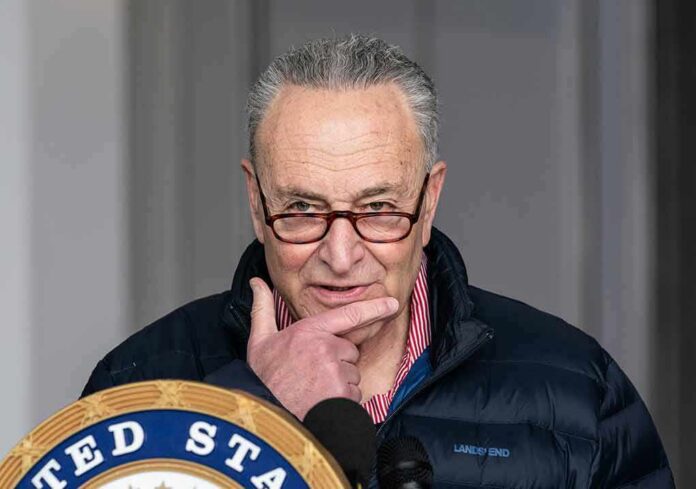
Senate Minority Leader Chuck Schumer stood outside a Brooklyn polling place and vowed his party would fight President Trump “tooth and nail” unless he changes direction on the economy.
Story Snapshot
- Schumer told reporters on Election Day, November 3, 2026, that Democrats will “fight Trump tooth and nail” over cost-of-living concerns.
- Schumer left the door open to cooperation, saying Democrats could work with Trump “if he changed his ways.”
- The White House points to falling drug prices, record energy output, and a 95% drop in border crossings as proof its agenda is working.
- Trump has said he would simply veto Democrat bills “veto, veto, veto” until they come to the table on his terms.
Schumer’s Brooklyn Vow Sets the Tone for a New Fight
Chuck Schumer cast his ballot at a Brooklyn school on November 3, 2026, then told reporters that President Trump “refused to listen” to voters worried about their bills. He said Democrats “are going to fight Trump tooth and nail, and focus on the issues no matter what he does.” The comment landed on an election day already framed around who controls the next Congress.
Schumer did not slam the door shut completely. He said Democrats could work with Trump “if he changed his ways and listened to voter concerns,” adding, “We’ll see if he’ll actually change his ways and join.” That caveat matters. It means the “tooth and nail” line is a bargaining position, not a blanket refusal to legislate — though reporters covering the race mostly ran with the combative headline.
A Familiar Playbook From Schumer’s Past Fights
This is not new territory for Schumer. Back in April 2025, after touring nursing homes, he used the identical phrase to describe his opposition to Republican spending cuts, saying “cutting it would be devastating, and that’s why we’re fighting it tooth and nail.” The pattern suggests Schumer treats “tooth and nail” as a go-to phrase for rallying his base, regardless of whether a detailed legislative plan backs it up.
Polling suggests Schumer’s base is hungry for exactly this kind of fight. A PRRI survey found 68 percent of Democrats call opposing Trump’s agenda a “critical issue,” compared with just 13 percent of Republicans. Pew Research separately found 63 percent of voters said Trump was a factor in their congressional vote, with far more voting against him than for him. Schumer’s rhetoric is aimed squarely at that energized Democrat base, not at building bipartisan deals.
The Record Trump’s Team Says Voters Are Ignoring
The White House argues Schumer’s “won’t listen” claim ignores a long list of results. Officials point to more than one million new private-sector jobs, trillions in new investment, and what they call the largest working-class tax cuts in history. They also cite a 95 percent drop in southwest border apprehensions compared to Biden-era levels, along with record U.S. oil and natural gas production in 2025.
On health care, the administration says price transparency rules and new drug-pricing deals are projected to save Americans more than $600 billion over the next decade. Taken together, these numbers form the core of the White House counter-argument: that Trump is already addressing the cost concerns Schumer says he’s ignoring, and that Democrats are opposing results, not failures.
Trump’s Own Answer: Veto First, Negotiate Later
Trump has already signaled how he’d handle a Democrat-controlled Congress if it comes to that. Asked in late October whether he could work with Democrats, he said plainly: “I’d veto, veto, veto, and then they come and they say how do we get it done, and you make a deal.” That answer mirrors Schumer’s own framing — both sides describe a relationship built on confrontation first, compromise only if forced.
What’s missing from Schumer’s vow is specifics. He never named a bill, a deadline, or a concrete demand that would satisfy him. Analysts note this vagueness lets Democrats claim the moral high ground on cost-of-living complaints without committing to any particular fix — a strategy that plays well on camera but offers voters little to hold either party accountable to.
For conservative voters already skeptical of Washington gridlock, Schumer’s promise reads as more of the same obstruction dressed up as concern for working families. With record energy production, falling border crossings, and tax relief already in place, the fight ahead looks less like a negotiation over new ideas and more like a rerun of old partisan battle lines.
Sources:
abc13.com, democrats.senate.gov, abc7chicago.com, whitehouse.gov, cambridge.org