

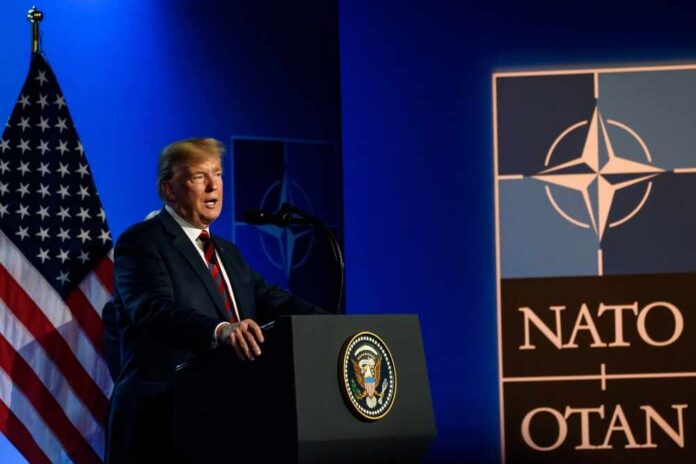
Washington may be legally blocked from quitting NATO outright, but the real shock is how easily any president could still “hollow out” America’s commitment without ever filing formal withdrawal papers.
Key Points
- Congress moved in late 2023 to restrict unilateral presidential withdrawal from NATO, requiring a supermajority in the Senate or an act of Congress.
- Even with that barrier, a commander-in-chief can still reduce NATO’s effectiveness through troop moves, exercise pullbacks, and selective participation.
- European governments are accelerating contingency planning, including an EU defense push described as “ReArm Europe” and a NATO spending target tied to 5% of GDP by 2035.
- Analysts warn that the biggest practical risk is not paperwork—it’s deterrence credibility under Article 5 if allies doubt U.S. follow-through.
Why NATO “exit” talk matters even when Congress says no
President Donald Trump’s second-term rhetoric about NATO has re-opened an old fight: whether the alliance protects U.S. interests or subsidizes countries that underinvest in their own defense. The key reality in 2026 is that there is no confirmed U.S. withdrawal underway. Still, the debate is active because legal limits on a formal exit do not necessarily stop day-to-day decisions that shape NATO readiness and credibility.
NATO’s structure depends heavily on U.S. capabilities that are hard to replace quickly, including intelligence, strategic lift, missile defense, and nuclear deterrence. That imbalance is one reason Trump’s burden-sharing argument resonates with many conservatives who are tired of open-ended commitments and federal overspending at home. It also explains why allies react sharply to threats, even if they are only rhetorical, because markets and adversaries respond to uncertainty long before treaties change.
The law: harder to quit on paper, easier to weaken in practice
Congress attempted to put guardrails on presidential authority with language tied to the National Defense Authorization Act in December 2023, limiting a president’s ability to withdraw the United States from NATO without Senate approval or an act of Congress. That change reduces the odds of a sudden, unilateral treaty exit. However, the commander-in-chief still controls force posture, exercises, deployments, and participation choices that can alter NATO’s muscle without triggering a formal departure.
That distinction—formal withdrawal versus functional retreat—is why analysts describe “hollowing out” as the more realistic scenario. NATO’s collective-defense promise under Article 5 is not just words; it rests on allied belief that the United States will respond fast and at scale. If U.S. participation becomes conditional or inconsistent, the alliance can look intact on paper while deterrence weakens in the real world. For voters who already distrust Washington’s competence, this is another example of how process and outcomes can diverge.
Europe’s contingency planning: spending targets and defense autonomy
European leaders have responded by pushing faster defense investment and greater self-reliance. Reporting in 2026 describes EU efforts under “ReArm Europe,” with figures discussed as high as €800 billion, aimed at strengthening European capacity if the U.S. role shrinks. NATO discussions have also highlighted a longer-term defense-spending ambition tied to 5% of GDP by 2035. The politics behind those numbers vary by country, but the direction is consistent: Europe is preparing for uncertainty.
Those developments cut two ways for American interests. On one hand, more European spending addresses a long-running U.S. complaint that too many wealthy allies free-ride on American taxpayers. On the other hand, a more autonomous European defense posture could reshape alliance decision-making, procurement, and priorities—potentially reducing U.S. leverage in the very institution America helped build after World War II. That tension explains why the current debate is not simply “stay or go,” but “what kind of alliance exists afterward.”
Deterrence, Russia, and the high stakes of mixed signals
NATO’s credibility matters most on its frontier, including states that worry about Russian aggression. Analysts argue that a major U.S. troop pullback from Europe—or any visible downgrade in readiness—could create a window of doubt about whether Article 5 would be honored in a crisis. Even absent a formal U.S. exit, allies could feel pressure to take unilateral steps, rush procurement, or adopt national strategies that make collective planning harder. The result could be a weaker deterrent posture at the worst possible time.
For Americans who want limited government and accountable spending, the core question is not whether alliances are inherently bad, but whether they are run with discipline and clear expectations. Trump’s supporters tend to see burden-sharing demands as common sense, while critics see destabilizing uncertainty. It doesn’t confirm an active withdrawal plan in 2026, but it does show real allied planning and real legal friction at home—signs that, once again, Washington’s internal politics are shaping global security as much as any battlefield.
Sources:
Trump pulling out of NATO explained
What would happen if the US left NATO