
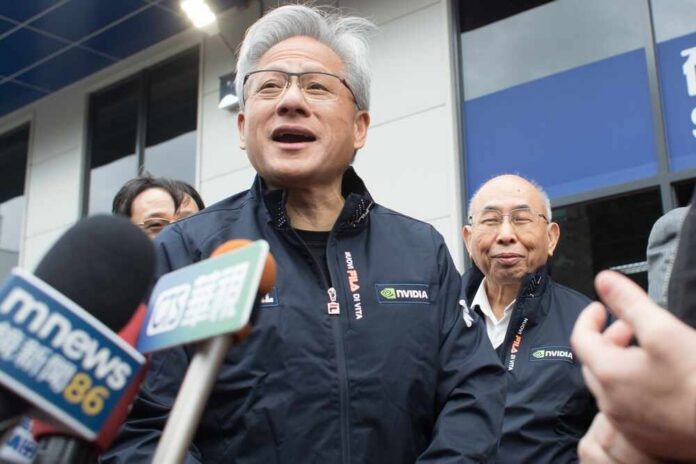
After months of hype about a jaw-dropping $100 billion OpenAI deal, Nvidia’s CEO just signaled the megacheck isn’t coming—raising fresh questions about whether the AI boom is being propped up by circular money and political “guardrails.”
Quick Take
- Nvidia CEO Jensen Huang said a $100 billion OpenAI investment is “probably not in the cards,” despite earlier public talk that the deal was close.
- Nvidia’s actual commitments highlighted this week were $30 billion to OpenAI (in a $110 billion round) and $10 billion to Anthropic, with Huang indicating those may be the last checks.
- Huang tied Nvidia’s pullback to expected IPOs for OpenAI and Anthropic later in 2026, a rationale some analysts dispute because late-stage private funding often continues pre-IPO.
- The shift suggests Nvidia may prefer the safer business of selling chips over taking ever-larger equity stakes in cash-hungry AI labs.
Huang’s “Probably Not” Rewrites the $100B Narrative
Jensen Huang delivered the headline at the Morgan Stanley Technology, Media & Telecom Conference on March 4, 2026, saying Nvidia’s once-discussed $100 billion OpenAI investment is “probably not in the cards.” The comment landed only days after OpenAI disclosed a massive $110 billion funding round that includes Nvidia’s $30 billion participation. Nvidia also has a separate $10 billion investment in Anthropic, which Huang suggested could be the end of Nvidia’s big equity pushes.
The timeline matters because Nvidia’s messaging has whipsawed. A $100 billion figure surfaced back in September 2025, linked to infrastructure plans and widely interpreted as part investment, part commercial arrangement. Subsequent filings warned the plan might not materialize, and reporting later suggested the arrangement was effectively paused. In late February 2026, Huang still described the OpenAI deal as close—making the early March pullback feel abrupt.
The IPO Explanation Leaves Gaps Analysts Keep Pointing To
Huang’s public rationale is straightforward: OpenAI and Anthropic are expected to pursue IPOs later in 2026, so Nvidia doesn’t plan to keep investing at the same scale once the companies are on a path to going public. The problem is that IPO planning doesn’t automatically stop late-stage funding, and large private rounds frequently continue right up until a listing. That disconnect is why commentary around Huang’s explanation has persisted.
One concrete issue raised in reporting is deal structure—especially the risk of “circular” arrangements where Nvidia invests in an AI lab and the lab turns around and spends heavily on Nvidia GPUs. Huang has denied “bad blood,” but the broader concern isn’t personal drama; it’s clarity. When investments and customer purchases blur together, outsiders have a harder time judging what’s real demand, what’s financial engineering, and what’s a strategic subsidy meant to keep the ecosystem dependent.
Nvidia’s Strategy Looks More Like “Sell Shovels,” Not Fund Every Gold Rush
Nvidia sits in an unusual position: it’s both a supplier to the AI boom and, increasingly, a financial participant in it. The company’s chips power the models behind headline products, and Nvidia has spent years deepening relationships across the AI stack. But Nvidia’s Q4 results showed how profitable the core business can be, with reports citing strong growth—strength that can make giant equity bets look less necessary, even if they remain strategically tempting.
The OpenAI round itself underscores how capital-intensive this space has become. OpenAI’s $110 billion raise included major commitments from Amazon and SoftBank, with Nvidia joining at $30 billion. That kind of money doesn’t go toward slogans; it goes toward compute, data centers, and the power costs of running frontier models at scale. If Nvidia chooses to step back from writing bigger checks, other investors may still step in, but pricing discipline and valuation pressure could rise ahead of any IPO targets.
Government “Guardrails” and Defense Ties Keep the Trust Question Alive
Politics hangs over all of this, because AI labs are not just consumer-tech firms anymore. Reporting around the same period referenced government contracting and “guardrails” meant to limit surveillance uses, with OpenAI adjusting aspects of a Pentagon-linked deal. For Americans wary of bureaucratic overreach, that context matters: when the biggest AI players mix defense work, massive private financing, and opaque governance, transparency becomes a public-interest issue, not a niche investor concern.
Jensen Huang says a $100 billion investment in OpenAI is 'probably not in the cards'. @OpenAI pic.twitter.com/Ji82STG71G
— Insider News (@ElectricNews3) March 5, 2026
What can be said with certainty from the available reporting is narrower than the online speculation. Nvidia has put real money on the table—$30 billion for OpenAI and $10 billion for Anthropic—while publicly signaling that the earlier $100 billion talk won’t happen. The open question is whether the IPO rationale fully explains the retreat or whether the industry is entering a more cautious phase where even the biggest winners prioritize predictable sales over headline-grabbing, high-risk bets.
Sources:
Nvidia CEO Jensen Huang says $100B OpenAI investment “probably not in the cards” as IPOs near
Nvidia’s Jensen Huang says OpenAI deal is “close”
Nvidia CEO Jensen Huang says it may not invest further in OpenAI, Anthropic with IPOs on the horizon