
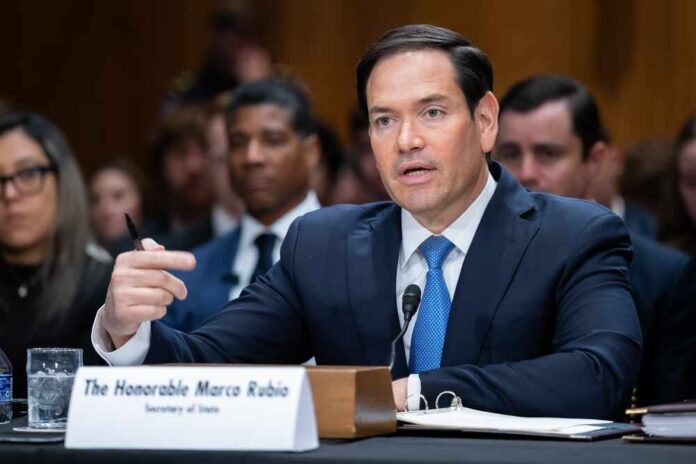
China bypassed its own sanctions on U.S. Secretary of State Marco Rubio by quietly changing the Chinese character for his name, letting the hawkish critic step onto Beijing soil for the first time since 2020.
Story Snapshot
- China sanctioned Rubio in 2020 over Xinjiang and Hong Kong criticisms, banning his entry.
- Trump’s 2026 Beijing visit forced a diplomatic fix: altered name transliteration evaded the ban.
- Rubio, now Secretary of State and National Security Adviser, boarded Air Force One on May 12.
- No formal sanction lift; Beijing prioritized summit stability over grudge.
- Move highlights pragmatic tensions in U.S.-China superpower rivalry.
Rubio’s Long Feud with Beijing Ignites Sanctions
Senator Marco Rubio drew China’s wrath in July and August 2020. Beijing sanctioned him twice for criticizing Xinjiang human rights abuses, Uyghur forced labor, and Hong Kong’s National Security Law. These measures froze his assets and prohibited entry into China. Rubio, a Cuban-American from Florida, authored the Uyghur Forced Labor Prevention Act and co-sponsored the Secure Equipment Act to block Huawei and ZTE gear. China mirrored U.S. tactics amid escalating trade wars.
Trump’s Reelection Reshapes the Chessboard
Donald Trump won reelection in 2024 and took office in January 2025, nominating Rubio as Secretary of State and National Security Adviser. Rubio met Chinese Foreign Minister Wang Yi twice outside China beforehand. Early 2026 saw Chinese state media switch Rubio’s surname transliteration, replacing the “lu” character tied to sanctions. Trump announced the Beijing trip in early May 2026, delaying confirmation until certain. This set the stage for high-stakes economic talks between the world’s top economies.
The “Lu” Loophole Unlocks Rubio’s Entry
On May 12, 2026, Rubio boarded Air Force One at Andrews Air Force Base with Trump, confirmed by the State Department despite the ban. China enabled entry without lifting sanctions by using the new name version in official contexts. This technicality marked the first visit by a sanctioned sitting U.S. Secretary of State. Beijing’s Foreign Ministry dodged questions, calling sanctions inquiries outside their purview. Rubio arrived in Beijing on May 13, participating in the summit.
China Scrambles to Use Bizarre Loophole to Host Marco Rubio After Sanctioning Him for Past Criticism https://t.co/zWqSr3BGSs
— Mediaite (@Mediaite) May 13, 2026
Pragmatism Trumps Ideology in Superpower Talks
China chose summit success over enforcing the ban, signaling foresight for stable U.S. ties. Rubio’s duty to accompany Trump overrode personal reluctance rooted in his anti-CCP stance. This workaround echoes Rubio’s own past efforts to close tech loopholes benefiting China, like his CHIPS Act warnings. From a conservative viewpoint, the facts show Beijing’s flexibility weakens sanction credibility long-term, yet stabilizes $500 billion trade vital to American jobs and security.
Short-Term Wins, Long-Term Risks Emerge
The visit smooths immediate trade and stability discussions, boosting China’s pragmatic image while embarrassing U.S. hawks. Uyghur and Hong Kong activists see diluted penalties. Businesses gain from eased tensions. Over time, normalized loopholes could invite U.S. retaliation, like tighter Chinese student visas. Congress allies may decry hypocrisy, but Trump’s deal-making prioritizes American interests over symbolic fights. Facts align with common-sense realism: superpowers bend rules for bigger gains.
Sources:
https://www.channelnewsasia.com/world/rubio-new-chinese-name-china-sanctions-6117271