

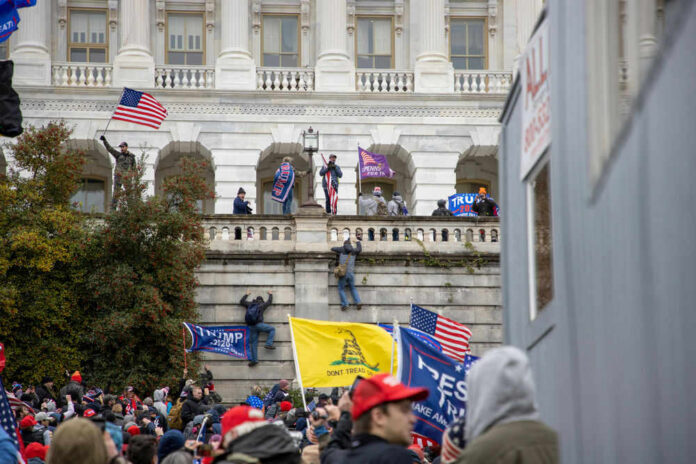
Justice Department leaders moved to wipe out seditious-conspiracy convictions for Proud Boys and Oath Keepers, igniting a high-stakes fight over whether prior prosecutions stretched the law and political power beyond constitutional bounds.
Story Snapshot
- Justice Department asked the appeals court to vacate January 6 seditious-conspiracy convictions and dismiss indictments [1][5].
- Filing cites prosecutorial discretion and interest-of-justice grounds rather than a new constitutional ruling [1][5].
- Democratic leaders highlight earlier jury verdicts after lengthy trials to oppose the move [2].
- Website changes removed prior January 6 case press releases, drawing scrutiny of record-keeping choices [4].
Justice Department Seeks Vacatur And Dismissal Of Seditious-Conspiracy Cases
Justice Department attorneys asked the United States Court of Appeals for the District of Columbia Circuit to vacate seditious-conspiracy convictions for members of the Proud Boys and Oath Keepers and to allow permanent dismissal of the indictments [1][5]. The request signals a sharp turn from earlier charging decisions that leveraged a rarely used Civil War-era statute. The government grounded its request in prosecutorial discretion and an interest-of-justice standard, not a new constitutional ruling that would automatically undo the verdicts [1][5].
Department officials framed the motion as a necessary course correction after reviewing the record, charging theories, and sentencing outcomes, which included terrorism enhancements in some cases. The filing’s emphasis on discretion underscores a common but controversial tool: new leadership reassessing politically charged matters and opting not to defend older cases on appeal. That approach invites legal, political, and cultural pushback because it can look like erasing jury work product and reinterpreting a national trauma through a different lens [5].
Opponents Cite Jury Verdicts And Trial Records To Resist Erasure
Democratic lawmakers and allied commentators responded by pointing to unanimous jury verdicts that followed lengthy trials with extensive evidentiary records. Representative Jamie Raskin, the senior Democrat on the House Judiciary Committee, emphasized that jurors convicted Oath Keepers leaders after weeks of testimony and exhibits, arguing those outcomes show the government met the high burden of proof beyond a reasonable doubt [2]. That rebuttal frames the Justice Department’s motion as political revisionism rather than a principled legal reassessment grounded in defects in the record.
The Department’s motion, as described in coverage, did not spotlight a discrete evidentiary error or constitutional defect that would require reversal, making the dispute turn on prudential choices rather than a black-letter legal command [1][5]. Critics contend that without a pinpointed legal flaw, vacating verdicts discounts the rule-of-law weight of jury deliberations. Supporters counter that seditious conspiracy was stretched to punish objectionable speech and group affiliation, and that dismissing the cases honors the First Amendment’s guardrails and the narrow, historic scope of the statute [5].
Record Management And Transparency Questions Add Fuel To The Debate
Media reporting noted that the Department removed prior web pages summarizing January 6 charges, convictions, and sentencings, triggering concerns about transparency and institutional memory [4]. Supporters of the removals argue that outdated or misleading summaries can prejudice ongoing reviews and that official records remain in court dockets. Skeptics view the takedown as symbolic cleansing that complicates public oversight at the precise moment the Department asks courts to unwind high-profile convictions tied to a national crisis [4].
This clash sits within a broader pattern where new administrations reassess politically salient prosecutions and sometimes decide that continuing to defend them undermines current enforcement priorities or institutional legitimacy [5]. Here, the stakes are acute: the seditious-conspiracy label carries extraordinary moral and legal weight, and its retreat will be read as either overdue restraint or capitulation. For conservatives who watched broad, speech-adjacent theories morph into felony convictions, the motion reads as a long-delayed correction toward constitutional boundaries [5].
What Comes Next: Appeals Court Timing, Practical Effects, And Guardrails
The appeals court must decide whether to grant vacatur and permit dismissal, a step that would end these prosecutions and clear the convictions from the ledger [1][5]. If approved, defendants would see seditious-conspiracy findings removed, though collateral issues like other counts, prior time served, and supervised release conditions may require case-by-case cleanup in district court. Lawmakers will continue pressing Department officials for testimony about criteria used, record retention, and how similar cases will be handled going forward [2][4][5].
Conservatives should watch three guardrails. First, does the court accept prosecutorial discretion as a sufficient basis to erase jury verdicts absent identified legal error [5]? Second, will the Department articulate clearer charging standards that avoid criminalizing heated political rhetoric protected by the First Amendment? Third, will institutional transparency improve, ensuring the public can audit how extraordinary statutes are invoked—or retired—when passions are hottest [4][5]? Those answers will shape whether this moment restores constitutional limits or merely resets the political battlefield.
Sources:
[1] YouTube – Trump’s DOJ wants to vacate the Jan. 6 convictions of Oath Keepers …
[2] Web – Ranking Member Raskin’s Statement on Trump DOJ’s Motion to …
[4] Web – Trump’s Justice Department scrubs its website of news releases …
[5] Web – DOJ moves to undo Jan. 6 rioters’ convictions fo – The Daily Record