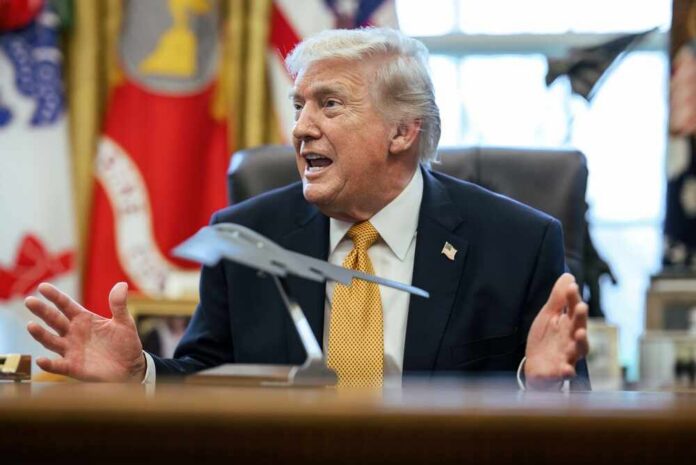
As President Trump vows to “drive out the forces of lawlessness and crime,” his Iran doctrine and law‑and‑order agenda mark a sharp break from the weak, muddled approach conservatives endured for years.
Story Snapshot
- Trump formally designates Iran’s nuclear and terror activities a “continuing unusual and extraordinary threat,” justifying tougher action.
- New powers to hit countries that buy from Iran with tariffs put real teeth behind “peace through strength.”
- Critics mock Trump’s claims of “obliterating” Iran’s nuclear potential but offer little hard evidence in response.
- The fight over Iran policy mirrors the broader battle between law‑and‑order conservatives and permissive, globalist elites.
Trump Frames Iran as a Core Lawlessness Threat to America
White House officials now state plainly that Iran’s push for nuclear capabilities, ballistic missiles, terror proxies, and regional destabilization is not just another foreign-policy debate but a continuing national-security emergency that demands intensified American action.[1] The February 2026 presidential fact sheet describes these activities as a “continuing unusual and extraordinary threat” to the United States, its allies, and its interests, language that triggers powerful emergency authorities under federal law and aligns with Trump’s broader promise to restore order at home and abroad.[1]
Trump’s team connects this threat assessment directly to the failures of the old Iran nuclear deal, which he refused to resurrect after returning to office.[2] The archived statement on leaving that agreement explains that the prior deal enriched Iran’s regime, allowed it to preserve nuclear research and development, and at best only delayed its ability to pursue nuclear weapons.[2] For conservatives who watched the political class sell that deal as a great success, the new language confirms what they long suspected: the agreement never truly restrained a hostile regime that despises American strength.
From “Unacceptable Deal” to Tariffs and Operation Epic Fury
Trump’s earlier withdrawal from the Iran nuclear agreement now looks like the opening move in a much larger law‑and‑order campaign against the regime.[2] That 2018 decision laid out specific demands: Iran must never have an intercontinental ballistic missile, cease developing nuclear‑capable missiles, and stop arming terror groups such as Hizballah, Hamas, the Taliban, and al‑Qaida.[2] The current White House fact sheet revives that list almost point for point, tying Iran’s missile program and proxy network directly to threats against global shipping lanes and American service members.[1][2]
The new order goes beyond speeches by giving the president the ability to impose tariffs on any country that continues buying Iranian goods or services, effectively daring foreign governments to choose between commerce with America or commerce with Tehran.[1] Trump presents this as a common‑sense extension of “America First” economics: nations that underwrite a terror state should pay a price in access to the world’s largest market. Critics worry about trade friction, but the administration argues that endless appeasement did nothing to stop rocket attacks, uranium enrichment, or hostage‑taking.[1][2]
Did the U.S. “Obliterate” Iran’s Nuclear Potential?
Trump has gone further than written fact sheets when speaking on camera, telling reporters that American military action “obliterated their nuclear potential” and describing Operation Epic Fury as one of the greatest military operations in United States history.[3] He also claimed Iran has agreed it will never have a nuclear weapon, calling that demand items “number one, two, and three” in any negotiation.[3] These statements are designed to signal that the days of half‑measures are over and that American power is back in a serious way.
The public record, however, shows that these most sweeping assertions rest almost entirely on Trump’s own description of events rather than on publicly released inspection reports or battle‑damage assessments.[1][3] No International Atomic Energy Agency report, declassified intelligence assessment, or technical study has been produced that independently verifies the claim that Iran’s nuclear infrastructure has been fully neutralized.[1][3] That gap gives hostile media and foreign propagandists a talking point, and it also reminds constitutional conservatives that even friendly administrations must eventually back big claims with real evidence.
Critics Attack the Strategy but Sidestep the Core Threat
Opponents have seized on the lack of public technical data to portray Trump’s Iran campaign as chaotic or self‑contradictory, highlighting shifts in rhetoric and negotiations to argue that the strategy is more political theater than coherent doctrine.[4][5] A Daily Show segment, for example, mocks Trump’s “Art of the Deal” approach, pointing to conflicting public statements about alleged concessions and timelines, while emphasizing the human and economic costs of confrontation without offering a clear alternative plan to halt Iran’s nuclear and missile advances.[5]
Yet even these critical broadcasts generally do not refute the basic facts that Iran pursued nuclear research, expanded its missile arsenal, and armed terror proxies across the region.[1][2][5] Instead they attack Trump’s tone, focus on short‑term diplomatic turbulence, or frame military pressure as inherently reckless.[4][5] For Americans who lived through years of empty red lines, rising global terror, and soft‑on‑crime politics at home, the contrast is stark: one side is at least willing to name and confront lawlessness abroad, while the other seems more animated by its dislike of Trump than by any serious plan to stop a regime that chants “Death to America.”
Sources:
[1] Web – Fact Sheet: President Donald J. Trump Addresses Threats to the …
[2] Web – President Donald J. Trump is Ending United States Participation in …
[3] YouTube – Trump on Iran: ‘We obliterated their nuclear potential’
[4] YouTube – Trump CALLS OFF strikes on Iran