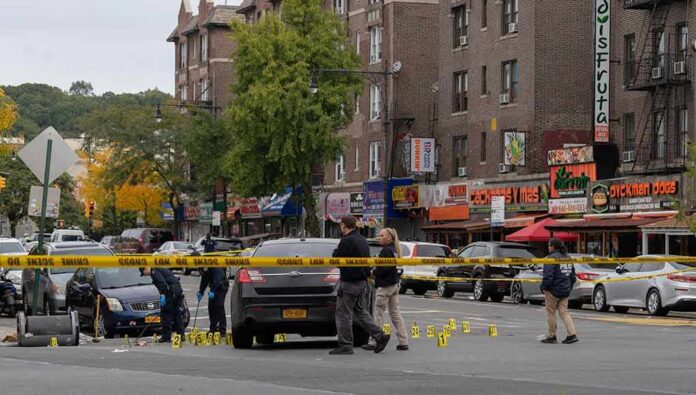
A Philadelphia police officer was killed and another wounded after prosecutors say a gunman opened fire on officers responding to a “man with a gun” call in West Philadelphia.
Story Highlights
- Prosecutors charged Eric Lewis, 35, with homicide of a law-enforcement officer and other felonies.
- Officer Shane Seiber, 40, a 10-year veteran and father of two, died after being struck three times.
- A second officer was shot multiple times and hospitalized; nine more officers were fired upon but not hit.
- The shooting began as officers approached a home on North 52nd Street shortly after midnight.
Charges Announced By District Attorney After Deadly Attack
Philadelphia District Attorney Larry Krasner identified Eric Lewis, 35, as the suspect and announced charges including homicide of a law-enforcement officer, murder, attempted homicide of a law-enforcement officer, attempted murder, aggravated assault, and related offenses. Krasner said Lewis allegedly shot two officers and fired at nine others during the incident. A court arraignment followed, and Lewis was denied bail, according to reporting that cited court records. NBC Philadelphia also reported the arraignment and custody status.
Police Commissioner Kevin Bethel said Officer Shane Seiber, 40, a 10-year department veteran and father of two, was struck three times and died at Penn Presbyterian Medical Center. Reporting from local outlets described the second officer as seriously or critically wounded after being hit multiple times. Officials said additional officers came under fire but were not struck. These details set the criminal counts and underscore the scale of risk the responding officers faced that night.
What Happened On North 52nd Street
The Philadelphia Inquirer reported that the call began shortly after midnight on the 100 block of North 52nd Street in West Philadelphia. Officers responded to reports of a man with a gun on a porch. The shooting began as officers approached the house, turning a standard response into a deadly attack. The quick timeline from arrival to gunfire tracks with how fast porch and doorway encounters can turn violent in dense city neighborhoods.
Officials said the suspect opened fire not only on the two officers who were hit but also at nine additional officers who responded. Prosecutors cited that conduct when outlining the long list of felony counts, which include multiple attempted murder charges tied to shots fired at uniformed police. The breadth of alleged targets shows how a single armed suspect can force many officers into a fight for their lives during what started as a routine check.
Status Of The Case And The Suspect
NBC Philadelphia reported that Lewis was arraigned, held without bail, and charged in connection with the killing of Officer Seiber and the wounding of a second officer. Those court actions place Lewis in custody as the accused shooter. While a conviction has not yet occurred, the charging decisions and detention order reflect the seriousness of the allegations and the danger prosecutors say he posed to officers and the public during the incident.
Local reporting identified Lewis as a Philadelphia Water Department employee and noted prosecutors’ account that gunfire was directed at multiple officers. Authorities have not released a full forensic timeline. However, the public record already anchors the core facts: a fallen officer, a wounded partner, a named defendant, and chilling allegations about gunfire aimed at a line of blue on a city street.
Why This Matters For Public Safety And Policing
Federal Bureau of Investigation (FBI) data show that firearms are involved in most felonious officer killings, while planned ambushes are a smaller share of those deaths. In the first nine months of 2024, the FBI reported 54 officers feloniously killed, with firearms used in most cases. Six of those killings were classified as ambushes involving entrapment or premeditation. Even if uncommon, these attacks devastate families and communities and demand strong, consistent accountability for violent offenders.
Philadelphia police officer Shane Seiber, 40, was killed in the line of duty on Saturday after being ambushed by a city worker with a lengthy criminal history.
Seiber is survived by his wife, a 7-year-old son, and a 3-year-old daughter.
His wife and other family members were… pic.twitter.com/ifpMwBGqgr
— Julia 🇺🇸 (@Jules31415) October 12, 2026
Police officers step into danger so the rest of us do not have to. This case shows how a porch call at midnight can become a deadly fight in seconds. Clear laws, tough charging decisions, and firm support for rank-and-file officers are all part of safeguarding our neighborhoods. As this case moves forward, leaders should back the badge, press for swift justice, and make sure frontline officers have the tools and training to stop the next attack before it starts.
Sources:
townhall.com, nbcphiladelphia.com, inquirer.com, cbsnews.com