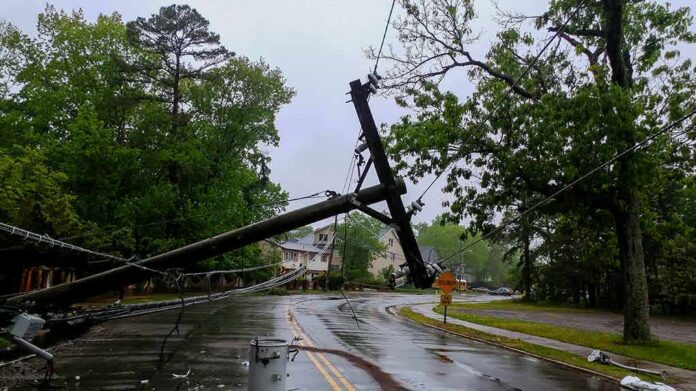
A Pensacola backyard shed went airborne as hurricane-force winds ripped across the Florida Panhandle, underscoring a storm that knocked out power to hundreds of thousands and toppled trees across the Southeast.
Story Highlights
- Powerful winds sent debris flying in Pensacola, including a backyard shed.
- Hundreds of thousands lost electricity across Florida, Alabama, and Georgia.
- Downed trees, damaged power lines, and flooded roads marked the impact zone.
- Federal and state teams staged rescue and recovery assets ahead of landfall.
High Winds Turn Ordinary Objects Into Dangerous Projectiles
Witnesses in Pensacola reported fierce gusts strong enough to lift a small backyard shed, showing how fast a storm can turn everyday items into hazards. Crews across Escambia and neighboring counties faced blocked streets from fallen limbs and scattered debris. Strong winds bent power poles and tore at older roofs. Flooded pockets formed where heavy rain overwhelmed drains. Local officials urged residents to stay off roads so first responders could clear lines and check on vulnerable neighbors.
Emergency managers warned that loose outdoor items can become airborne in hurricane conditions. Residents who secured grills, yard tools, and patio furniture reduced risk to themselves and their neighbors. The shed incident highlights why simple steps—tying down gear, reinforcing gates, trimming weak branches—matter before storms arrive. Utility crews moved in behind the wind bands to cut trees off lines and restore power. Many streets reopened only after chainsaw teams cleared snarls of limbs and snapped trunks.
Widespread Outages Hit Florida, Alabama, and Georgia
Regional outage trackers showed more than 668,000 electricity customers without power across Florida, Alabama, and Georgia at one point, including roughly 409,000 in Florida after landfall. A separate report cited 834,061 customers without power across the Southeast at 5 a.m., including 436,443 in Florida, 314,540 in Alabama, and 83,078 in Georgia. Different timestamps and coverage areas explain the range. For families, that meant dark homes, limited phone charging, and spoiled food if backup plans were not in place.
Downed trees and damaged lines caused most of the early outages as wind peeled limbs into wires and toppled poles. Flooded roads slowed some restoration, as crews waited for water to drop before moving large trucks. Local officials asked drivers to treat dark intersections as four-way stops and to never touch downed lines. Utilities reminded customers that linemen need clear shoulders and patient drivers to work safely. Restoration priorities started with hospitals, water systems, and critical facilities.
Prepared Teams, Clear Priorities, Faster Recovery
The Federal Emergency Management Agency reported that its National Response Coordination Center and Region 4 center were activated, with search and rescue teams staged near the impact area. Incident Management Assistance Teams deployed to Florida and Alabama to support state coordination. Those steps help move supplies, open shelters when needed, and guide power restoration. Florida’s statewide readiness posture has improved in recent years, and that planning trimmed hours off early response timelines.
Florida leaders provided updates on road clearing, power restoration, and community needs as conditions improved. Local sheriffs focused on welfare checks for seniors and families in low-lying zones. County crews assessed traffic lights, bridges, and drainage points. School districts weighed building safety before reopening. Public works teams worked shoulder to shoulder with electric co-ops and investor-owned utilities, showing how a clear chain of command speeds the recovery for working families and small businesses.
What This Means For Families And Property Owners
Storms like this test more than the grid. They test personal readiness and neighborhood ties. Homeowners who secured yards, cleaned gutters, and reinforced sheds fared better. Strong winds will find the weak point—loose shingles, rotted fence posts, or unanchored outbuildings. A flying shed proves the point. Simple steps cut damage: anchor structures to ground screws, reinforce doors, add hurricane clips, and keep trees trimmed away from roofs and lines. This is common-sense stewardship that protects family and property.
For the next storm window, families should build a 72-hour plan. Store water, shelf-stable food, medicines, and batteries. Keep gas tanks at least half full. Photograph key rooms for insurance and back up files. Know the local shelter options. Check on older neighbors. When government at all levels prepares well, and when citizens take responsibility at home, communities ride out the hit and bounce back faster. That is the American way—self-reliance paired with neighborly duty, under law and order.
Sources:
feedpress.me, nbcnews.com, bbc.com, firstcoastnews.com