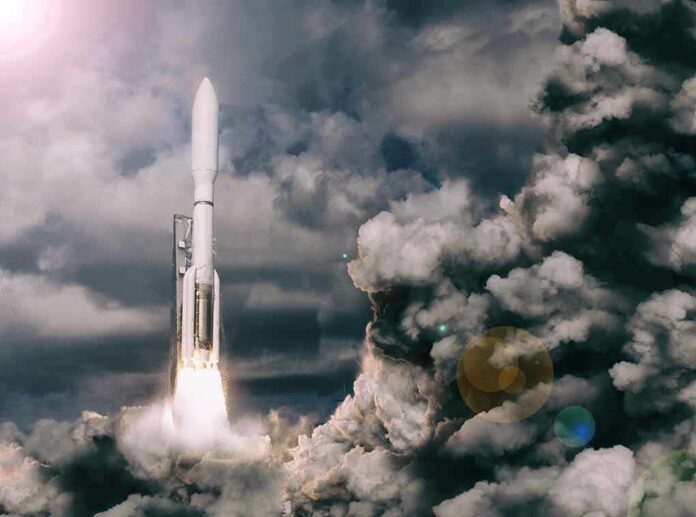
NASA’s own records show SpaceX’s reuse model slashed launch costs, while rival Blue Origin races to prove it can match the savings.
Story Highlights
- NASA documented sharp Falcon 9 cost advantages tied to reuse and lean development.
- A NASA mission flew on a reused SpaceX booster for $50.3 million, undercutting legacy options.
- NASA funded two lunar landers, SpaceX and Blue Origin, to avoid single-vendor risk.
- Contract values have already increased, showing competition alone does not freeze costs.
What NASA’s Data Says About Cost: Reuse Drives Real Savings
NASA’s 2020 technical report measured hard numbers, not hype. The agency recorded an advertised $62 million Falcon 9 price for lifting 22,800 kilograms to low Earth orbit, or about $2,720 per kilogram. The same study estimated SpaceX’s development costs at $443 million versus $1.383 billion under legacy methods, a 68 percent cut. These figures point to a simple driver: reuse and a tighter contract model cut waste and deliver value to taxpayers, mission planners, and the national interest.
SpaceX’s lower price did not live only on a slide. NASA selected a Falcon 9 for the Imaging X-ray Polarimetry Explorer mission at a total of $50.3 million. The rocket used a previously flown first stage. A NASA spokesperson said the reused booster helped push the price lower. That outcome also showed how legacy expendable choices, like Pegasus, struggled to compete even for smaller payloads. Reuse translated into a check the agency could cash, not a promise on paper.
Two Lunar Landers, One Goal: Reducing Strategic Risk for America
NASA chose two separate human lunar-landing systems to avoid relying on a single provider. The agency’s Office of Inspector General reported firm-fixed-price awards to SpaceX and Blue Origin. Original potential values were about $4.3 billion for SpaceX and $3.1 billion for Blue Origin. Funding two designs keeps a backup on the bench and incentivizes performance. It also aligns with conservative sense: spread risk, test ideas in parallel, and pay for results rather than endless cost-plus overruns.
The dual-track approach has not been free of bumps. The Inspector General reported contract increases through December 2025 totaling $266 million. About $253 million, or 6 percent, was added to SpaceX’s effort, and $13 million, or under 1 percent, to Blue Origin’s. Those numbers do not erase the gains from reuse. They do show that competition alone will not hold costs flat in complex human-spaceflight work. Oversight and milestones still matter when billions and schedules are on the line.
Musk–Bezos Rivalry: Real Benefits, Real Limits, and What Comes Next
The public loves the Musk versus Bezos story. The Atlantic’s account casts both men and their companies as central to the next phase of exploration. That framing captures attention but can blur the core point: measured savings so far come most clearly from SpaceX’s reuse and contracting approach. Blue Origin is a player, but the record described it as slower to reach orbital competition. The rivalry is real, but the proof of cost cuts hinges on operations, not headlines.
For conservatives, the lesson is clear. Market discipline can beat bloated spending when agencies buy services and demand results. NASA proved reuse lowers launch costs and can speed mission cadence. At the same time, America must guard against vendor lock-in and scope creep. Keeping two lunar-lander lines alive protects national capability. Tight contracts, clear milestones, and tough audits protect taxpayers. That balance serves exploration, strengthens security, and respects the people who fund the mission.
Sources:
theatlantic.com, bgr.com, ibtimes.com