
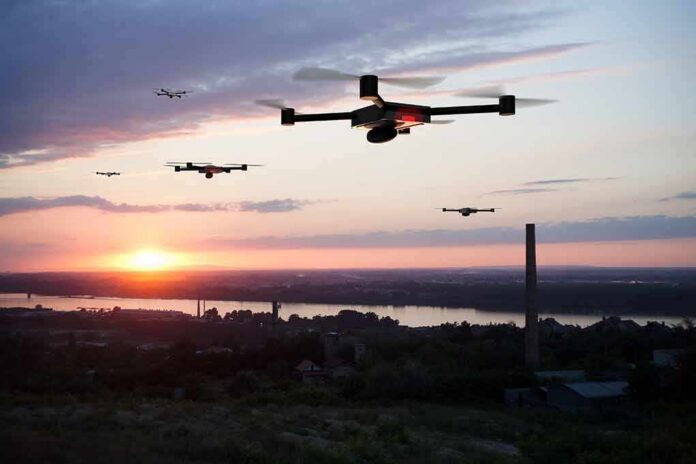
The Los Angeles Police Department is moving to double its crime-fighting drone fleet, raising hard questions about safety, privacy, and how far government eyes in the sky should go.
Story Snapshot
- LAPD plans to expand its electric drone fleet from 13 to 26 to fight serious crimes amid a cop shortage.
- Leaders say drones cut response times, protect officers, and can even resolve some 911 calls without face-to-face contact.
- The program has already logged more than 3,500 deployments in a single year, showing this is now routine, not rare.
- Updated rules let drones watch protests, large events, and “calls for service,” stoking civil-liberty and surveillance fears.
LAPD doubles drone fleet as staffing crisis deepens
Los Angeles Police Department leaders are pushing a major expansion of their Drone as First Responder program at the same time the force faces a long-running officer shortage. The department plans to grow its electric drone fleet from 13 to 26 aircraft, using them to respond to homicides, kidnappings, burglaries, and other high-risk calls. Officials frame the move as a way to keep citizens safe while stretched manpower limits how many patrol officers can be on the street.
The expansion is backed by outside money as well as city support, which raises fair questions about who is steering policy. A $2.1 million donation from the Los Angeles Police Foundation, approved by the city’s civilian oversight board, is paying for new drones and docking stations around the city. Additional funding and contracts with drone maker Skydio help build a network of launch sites and automated systems, turning drones into a regular part of the city’s law-enforcement infrastructure.
How the Drone as First Responder program works
Under the Drone as First Responder program, unmanned aircraft are launched to 911 calls to get “eyes on scene” before officers arrive in person. Drones carry high-definition video and thermal imaging, streaming live footage into a command center so supervisors can see if suspects are armed, where victims are located, and what dangers officers may face. In some cases, commanders can cancel or scale back patrol units when the drone shows the situation is less serious than the initial emergency call suggested.
A police report on the pilot program shows how quickly drones have become a normal tool. In 2025 alone, the department deployed drones more than 3,500 times, often beating patrol cars to the scene and feeding real-time information to officers. Officials say these flights helped resolve some calls without direct officer contact, which they argue saves limited manpower and may reduce the chance of tense confrontations. The department claims that in nearly 9 percent of responses, drone footage allowed them to cancel patrol units, and that drones provided essential information in roughly 89 percent of deployments.
Supporters say drones boost safety and cut costs
LAPD commanders argue the drone expansion is about smarter policing, not replacing cops with machines. They describe drones as a “force multiplier” for a lean department, letting fewer officers cover more ground while still responding to serious crimes across a large and complex city. Officials also note that drones are meant to complement, not replace, the department’s fleet of 17 helicopters, one of the largest municipal air units in the world. Drones are cheaper to fly than helicopters and can be launched quickly from local docks when seconds matter.
Backers inside and outside the department say this kind of technology can save lives when used well. Real-time video can warn officers about ambush risks, reveal hidden suspects, and guide special units in hostage or barricade cases. The mission statement on the program’s public portal is clear: protect both citizens and first responders by getting better information faster. At a time when many big cities struggle with violent crime and fewer officers, supporters see drones as one more tool to keep neighborhoods safe without demanding even bigger budgets.
Privacy, protest monitoring, and government overreach concerns
Civil-liberties advocates and many everyday citizens are more wary, especially as drone rules quietly grow wider than simple emergency response. An updated policy approved by the Los Angeles Police Commission allows drones not just for 911 emergencies, but for routine “calls for service,” high-risk incidents, investigations, large-scale events, and natural disasters. The same policy permits drone monitoring of mass protests “for safety reasons,” while promising not to track demonstrators who are not committing crimes. To many conservatives and privacy-minded Americans, those carve-outs sound like the first steps toward normalized crowd surveillance.
LAPD chief reveals plan to double drone fleet to tackle homicides, kidnappings and burglaries amid cop shortage. https://t.co/0RMNjxjKjk#Security #Drones #LawEnforcement #PublicSafety #CrimePrevention #ExecutiveProtection #SecurityTrends #LAPD #PoliceTech #ThreatManagement
— The World Protection Group "We Protect Your World" (@WPG_Security) July 24, 2026
The citywide plan also talks openly about “real-time aerial surveillance capabilities,” with drones stationed at shopping centers and police sites and able to roam two to three miles from each dock. While the department says it does not use drones for patrols and is “not interested in recording you” unless a crime is involved, critics note that the public has not seen full flight logs, data-retention rules, or independent audits of how footage is stored and accessed. The mix of private foundation funding, expanding rules, and fast-growing deployment numbers leaves many wondering whether Los Angeles is quietly building a permanent, always-on eye in the sky that future leaders could abuse.
Sources:
nypost.com, police1.com, laist.com, nationaltoday.com, youtube.com, latimes.com