
U.S. and Saudi jets just hammered Iran-backed militants in Iraq after a blitz of drone attacks on American troops and Saudi oil facilities, raising big questions about how far this shadow war will go next.
Story Snapshot
- The U.S. and Saudi Arabia carried out joint precision airstrikes on Iran-aligned militants in eastern Iraq after more than 30 drone attacks in 72 hours.
- CENTCOM says the militants, directed by Iran’s Islamic Revolutionary Guard Corps, targeted U.S. forces and Saudi energy infrastructure but failed to cause U.S. casualties.
- Saudi Arabia calls the strikes an act of self-defense under the United Nations Charter, after intercepting drones aimed at critical oil facilities.
- Over 600 attempted attacks on U.S. citizens and facilities in Iraq since February show a steady campaign against American and allied interests.
Joint U.S.–Saudi Strike Sends a Message After Drone Barrage
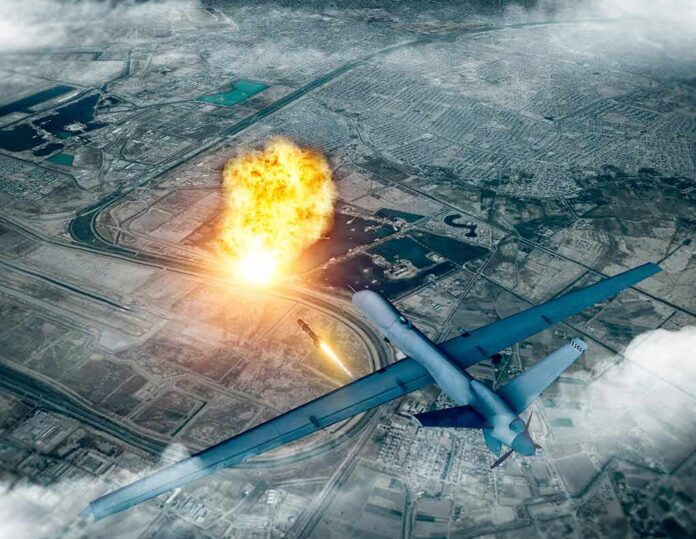
U.S. Central Command reports that U.S. and Saudi Arabian fighter jets carried out precision strikes on militant targets in eastern Iraq on July 28. The command says these targets were “Iran-aligned terrorists” guided by Iran’s Islamic Revolutionary Guard Corps to attack U.S. forces and Saudi energy infrastructure. Military planners describe the strikes as a direct response to more than 30 aerial drone attacks launched in just three days. None of those drone attacks successfully hit U.S. forces, but commanders warn that the threat is constant.
Saudi officials back up the U.S. account and say their forces helped hit militia positions tied to cross-border attacks on the kingdom’s oil facilities. The Saudi Ministry of Defense says air defenses intercepted drones launched from Iraqi territory toward key petroleum sites in the Eastern Province and around Riyadh. After those interceptions, Saudi leaders coordinated with U.S. Central Command to strike weapons and logistics hubs used by the militants. For energy-dependent families here at home, that means another reminder that hostile groups are willing to target the fuel that powers our economy.
Growing Iranian-Backed Threat to U.S. Forces and Energy Security
The U.S. military says this week’s drone wave is not a one-off event but part of a long pattern of harassment. Central Command reports that from February through April 2026, Iran-aligned militias in Iraq tried more than 600 times to hit U.S. citizens and facilities. Many of these attacks used drones and rockets, aimed at bases where American service members work to keep terrorists in check. This campaign also targets Saudi and other Gulf energy infrastructure, putting global oil supplies and prices at risk for everyday consumers.
Regional reports say Saudi warplanes have already struck militia sites in Iraq earlier in the wider Iran conflict, including facilities used for launching drone and missile attacks against Saudi Arabia and other Gulf states. In at least one case, a site tied to the militia group Kataib Hezbollah was destroyed, including a communications and drone operations center. These facts show that militant networks inside Iraq are being used as forward bases for Iran’s proxy war. For Americans worried about gas prices and world stability, these bases are not some far-off problem; they feed turmoil that reaches right into our wallets.
Self-Defense, Sovereignty, and Risks of a Wider War
Saudi Arabia publicly frames the joint strikes as a lawful act of self-defense under Article 51 of the United Nations Charter. Their statement says the kingdom has a right to defend its territory and energy facilities from cross-border attacks launched by militias operating out of Iraq. For many conservatives, that argument rings familiar. It parallels our belief that nations must protect their people, their borders, and their resources without waiting for permission from global bureaucrats or hostile neighbors.
🚨🇮🇶BREAKING: New images reveal heavy damage at PMF positions in Iraq following coordinated US–Saudi airstrikes.
Sites in Diyala and Kirkuk were hit, including the Shahid Abu Muntazar al‑Mohammadawi camp. The PMF says the broader wave of strikes has killed at least 20 personnel… pic.twitter.com/KJeQ8KLO4y
— Eye OSINT (@AlexiaNoel94927) July 29, 2026
At the same time, important questions remain. Central Command has not yet named specific militia units tied to each drone attack or released public forensic proof matching each targeted site to particular strikes. Much of the evidence is likely based on classified intelligence, which limits outside scrutiny. That means citizens must weigh trust in the military’s word against the desire for more open proof. Critics warn that Iraq risks being pulled deeper into the Iran conflict, as foreign powers hit groups on its soil while Baghdad struggles to control every armed faction.
What This Means for American Patriots Watching the Middle East
For conservative Americans, several themes stand out from this operation. First, Iran’s network of militants is clearly focused on U.S. troops and the energy lifelines of our allies, which can drive up costs and threaten our economy. Second, President Trump’s administration is not sitting back; the strikes show a willingness to answer attacks quickly and protect American lives and interests abroad. Many readers will see this as a needed break from years of weak responses and mixed signals in the Middle East.
Still, a long campaign of tit-for-tat strikes carries risks for our troops and our budget. Every drone, jet sortie, and missile defense system costs money that Americans ultimately fund. As this shadow war continues, citizens who value limited government and clear war powers will want Congress to keep tight oversight on any wider escalation. For now, the message from the skies over Iraq is simple: Iran’s proxies tested U.S. and Saudi resolve, and they got hit back hard.
Sources:
cbsnews.com, reuters.com, fakti.bg, rt.com