

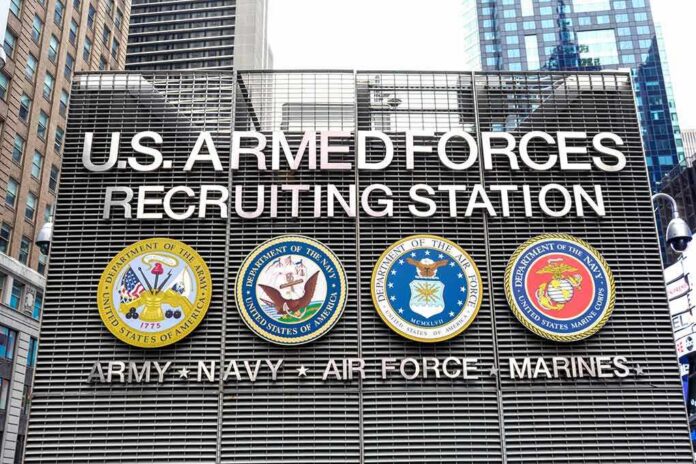
After years of woke distractions and recruiting shortfalls, the U.S. Army has stunned Washington by smashing its 2026 enlistment goal four months early, thanks to a back-to-basics focus on service, opportunity, and serious reforms.
Story Snapshot
- The Army hit its 2026 active-duty recruiting goal of about 61,500 contracts four months ahead of schedule, marking one of the strongest comebacks in years.
- Officials credit targeted reforms like the Future Soldier Preparatory Course, higher pay, and faster processing for turning a recruiting crisis into a surge.
- Defense leaders tie the rebound to President Trump’s push for stronger readiness and better career paths for patriotic young Americans.
- Structural fixes and renewed interest in service suggest a long-term shift away from failed woke-era priorities toward mission, merit, and opportunity.
Army Recruiting Roars Back After Years of Struggle
The United States Army now reports it has reached its fiscal year 2026 active-duty recruiting goal months ahead of deadline, signing contracts with more than 61,500 future soldiers. This marks a sharp turn from the crisis just a few years ago, when the Army missed its targets by tens of thousands and senior leaders worried openly about the force’s long-term strength. That slump came after years of cultural confusion, school shutdowns, and fierce competition from private employers, all of which made it harder to bring in qualified volunteers. Today’s surge is being described by defense officials as the best recruiting environment in roughly fifteen years, with other services also meeting or exceeding their goals.
Defense Secretary Pete Hegseth and senior Pentagon leaders say this rebound did not happen by accident; it was engineered through a mix of policy changes, incentives, and clearer messaging about service and patriotism. Under President Trump, Congress passed three straight pay raises above four percent, with junior enlisted troops getting an extra bump that makes starting pay much more competitive for working-class young Americans. At the same time, the services poured money into enlistment bonuses and “quick ship” contracts that reward recruits who are ready to report to basic training quickly. For many families squeezed by inflation and uncertain jobs, those paychecks and benefits make military service look like a serious, respectable path again.
Future Soldier Course and Structural Fixes Drive the Surge
Experts who track recruiting agree one of the biggest game changers has been the Army’s Future Soldier Preparatory Course at Fort Jackson, South Carolina. Launched in 2022, this program gives lower-scoring or out-of-shape applicants up to ninety days of academic tutoring and fitness training so they can meet standards and move on to basic training. In one recent year, about 13,000 recruits—roughly one in four of the Army’s 55,000 new soldiers—came through the course, and Army Secretary Christine Wormuth has said it may account for nearly a third of that year’s totals. Rather than quietly lowering standards, the course helps motivated young people rise to meet them, widening the eligible pool without sacrificing readiness.
Beyond that single program, the Army has overhauled how it chooses and manages recruiters, treating recruiting as a professional career field instead of a temporary side duty. The chief of recruiting now reports directly to the Secretary of the Army, and recruiters train with major companies like Amazon and Wells Fargo to learn modern talent-hunting methods. The Army also relaunched the classic “Be All You Can Be” campaign with a full digital and broadcast rollout, pushing a message of personal growth and warrior ethos instead of vague social slogans. Combined with expanded medical waivers and a pilot program that speeds up access to medical records, these changes cut red tape and keep willing applicants from giving up during long waits.
Patriotism, Purpose, and Trump-Era Readiness
While analysts are clear that structural reforms matter, there is also a cultural story that resonates with conservative Americans: more young people are again open to the idea of serving their country in uniform. Commentators note a renewed “warrior ethos,” more visible ceremonies, and broader recognition of veterans, all of which make military service feel honorable and respected instead of suspect or outdated. For many recruits, the Army now offers a way to find purpose, build skills, and stand up for the nation’s security at a time of global uncertainty and rising threats. That appeal fits squarely with President Trump’s America First message, which stresses strong borders, respect for law, and a military focused on winning, not on social experiments.
There is an important nuance: independent reporting shows that the recruiting upswing began before Trump’s reelection, after reforms launched under earlier budgets. Analysts from universities and think tanks credit bigger pay raises, enhanced bonuses, more recruiters, and smarter management as core drivers of the turnaround. But these same voices say the Trump administration has doubled down on those fixes, pushing for continued pay growth, more enlistment support, and stronger outreach. The message for patriotic readers is straightforward: when leaders stop chasing woke agendas and focus on readiness, standards, and opportunity, young Americans respond by stepping forward to serve.
What This Rebound Means for Conservative Families
For many conservative families who watched the military struggle under mixed messages and political culture wars, the Army’s recruiting comeback offers cautious hope. The numbers suggest that when the services protect standards, reward hard work, and clearly honor those who serve, the uniform again becomes something parents can support and kids can be proud to wear. At the same time, experts warn challenges remain: the military still faces a shrinking pool of eligible teenagers and must guard against any slide back into politics, lowered expectations, or wasteful spending. For now, though, the trend is positive—proof that a strong, focused America can still inspire its sons and daughters to raise their right hand.
Sources:
facebook.com, army.mil, wabcradio.com, military.com, youtube.com, prhome.war.gov, military.net, voanews.com, businessinsider.com, nationalsecurityjournal.org, deseret.com, recruiting.army.mil