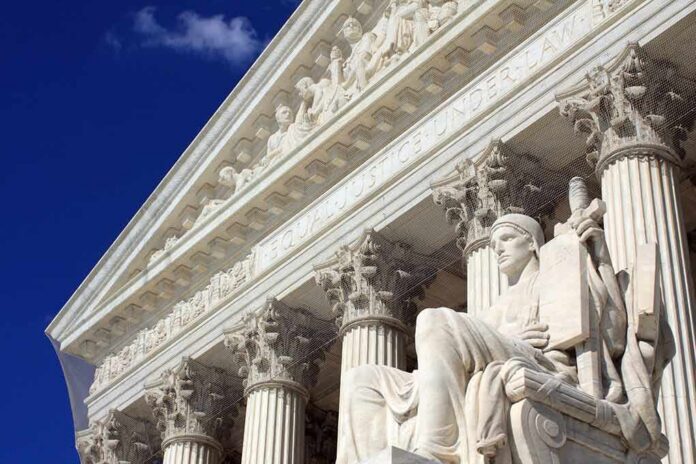
The Supreme Court shut the door on reviving plea deals for the 9/11 plotters, keeping the death penalty back on the table and restoring long-delayed accountability.
Story Highlights
- The Supreme Court declined to hear appeals to restore 2024 plea deals for 9/11 defendants.
- The decision leaves in place a ruling that former Defense Secretary Lloyd Austin could cancel the deals.
- The abandoned plea deals would have spared the death penalty in exchange for guilty pleas and cooperation.
- The 9/11 case has dragged on for years amid disputes over evidence and process.
Supreme Court Leaves Appeals Court Ruling Intact
The United States Supreme Court on October 19 declined to review Khalid Sheikh Mohammed’s bid to restore 2024 plea agreements that would have removed the death penalty in exchange for guilty pleas and cooperation. The unsigned order leaves standing a decision by the United States Court of Appeals for the District of Columbia Circuit holding that former Defense Secretary Lloyd Austin had legal authority to withdraw from those deals. The court’s move keeps capital charges on the table for the accused 9/11 planners.
News outlets report that the plea framework, approved within the Guantanamo war court system, would have ended more than two decades of pretrial delays by securing immediate guilty pleas. After internal approvals, Austin stepped in and canceled the agreements, citing the gravity of the case. By declining review, the justices allowed that revocation to stand, closing the path the defendants sought to lock in life sentences rather than face possible execution.
How The Dispute Arose Inside The Guantanamo System
The 2024 plea offers were negotiated by military prosecutors and cleared through the Guantanamo tribunal’s leadership before Austin reversed course two days later. A military judge later said the agreements were “valid and enforceable,” but the civilian appeals court disagreed, concluding Austin “indisputably” held the power to withdraw from them. The Supreme Court’s refusal to hear the case cements that reading of authority within the military commission framework for this prosecution.
The clash reflects layers of command and legal control unique to the commissions. Congress, through the Military Commissions Act, permits plea bargaining, but the chain of command still runs to the Secretary of Defense. Austin asserted that the decision’s significance required his direct sign-off. The appeals court accepted that view, and now, with the high court stepping back, the government proceeds without those plea limits on punishment.
What This Means For Accountability And Timelines
The ruling clears a key obstacle that could have locked in life sentences and removed capital punishment from the case. Families of the nearly 3,000 murdered Americans have waited a generation for a final judgment. Prosecutors keep leverage, and the death penalty remains available if a jury convicts. Yet the path to trial is still complex, with years of litigation over detainee treatment and evidence admissibility shaping what can be used in court.
The Supreme Court rejects an appeal brought by Khalid Sheikh Mohammed and two other alleged 9/11 plotters seeking to hold the government to a plea deal it later withdrew. https://t.co/ortafgoDi9
— NBC News (@NBCNews) October 20, 2026
Analysts warn that earlier torture claims and classified evidence fights have slowed the process and may continue to do so. That history explains why some officials tried to trade certainty for speed with plea deals. With those deals off, the task now is to press forward, apply the law cleanly, and deliver a verdict worthy of the loss endured on September 11. The decision signals that leniency through process shortcuts is not the answer here.
The Conservative Bottom Line
The Supreme Court’s choice aligns with a simple principle: punishment must fit the crime, and grave crimes deserve the full measure of justice. Allowing a backroom bargain to spare the worst terrorists the harshest penalty would have undermined faith in the system. This outcome respects victims, supports deterrence, and rejects an approach born of bureaucratic confusion and past policy failure. The government must now move briskly, follow the rules, and finally deliver closure consistent with American law.
Sources:
insiderpaper.com, scrippsnews.com, spokesman.com, usatoday.com, americanbar.org, apnews.com