

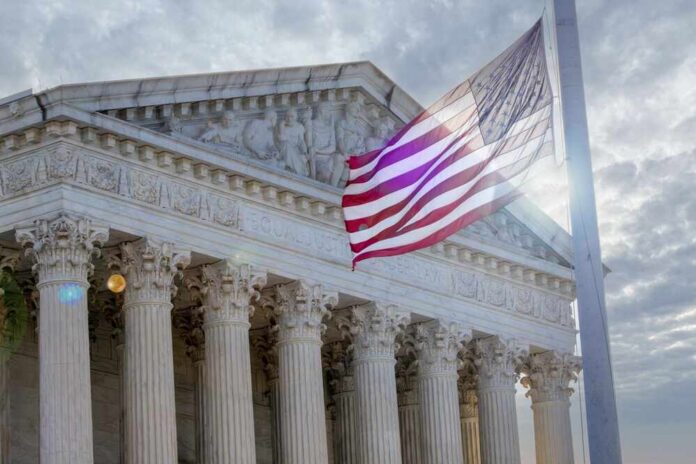
President Trump’s second-term executive order attempting to end birthright citizenship for children of undocumented immigrants faces Supreme Court scrutiny on April 1, 2026, after every lower court has declared it unconstitutional—raising serious concerns about executive overreach that bypasses Congress to rewrite the Constitution.
Story Snapshot
- Trump’s January 2025 executive order denies automatic citizenship to U.S.-born children of undocumented or temporary non-citizen parents, blocked by courts since July 2025
- Supreme Court oral arguments scheduled for April 1, 2026, with decision expected by summer in Trump v. Barbara case
- All lower courts ruled the order unconstitutional, contradicting 14th Amendment text and 126 years of Supreme Court precedent
- Order could affect tens of thousands of American-born children annually and cast doubt on citizenship for millions of descendants
Executive Order Redefines Constitutional Citizenship Without Congress
President Trump signed Executive Order No. 14,160 on January 20, 2025, his first day in office, directing federal agencies to deny birthright citizenship to children born on U.S. soil if their mothers are unlawfully present and fathers lack citizenship or permanent residency. The order reinterprets the 14th Amendment’s Citizenship Clause—”All persons born or naturalized in the United States, and subject to the jurisdiction thereof, are citizens”—claiming it excludes children of undocumented immigrants. This represents the first presidential attempt to unilaterally redefine constitutional citizenship without congressional action, a move that every court reviewing it has rejected as overstepping executive authority and contradicting explicit constitutional text.
Courts Block Enforcement Amid Immediate Legal Challenges
The ACLU and allied organizations filed class-action lawsuits within days of the order’s signing, representing families whose newborns were denied citizenship documents. U.S. District Judge Joseph Laplante issued a preliminary injunction on July 10, 2025, blocking enforcement and certifying a class of affected children, ruling the order “contradicts the 14th Amendment.” The Trump administration bypassed the 1st Circuit Court of Appeals, petitioning the Supreme Court directly for certiorari on September 26, 2025. The Court granted review on December 5, 2025, leapfrogging normal appeals processes to address whether the executive order complies with the Constitution and federal law. No child has been denied citizenship under the order due to continuous injunctions since February 2025.
Historical Precedent Contradicts Administration’s Constitutional Interpretation
The 14th Amendment’s Citizenship Clause was ratified in 1868 to grant citizenship to freed slaves after the Civil War, but the Supreme Court’s 1898 decision in United States v. Wong Kim Ark extended birthright citizenship to children born in the U.S. to non-citizen parents, excluding only diplomats’ children and invading military forces. Trump argues the phrase “subject to the jurisdiction thereof” limits citizenship to descendants of slaves, contradicting over a century of legal precedent. Constitutional experts and legal analysts note the administration’s reading ignores both the amendment’s plain text and its application across generations. This interpretation raises alarms among constitutional conservatives who recognize that allowing a president to rewrite foundational citizenship law through executive fiat—rather than the amendment process outlined in Article V—undermines constitutional limits on executive power.
Case Threatens Citizenship Security for Millions of Americans
If the Supreme Court upholds Trump’s order, tens of thousands of U.S.-born children each year would lose automatic citizenship, creating a multi-tiered system based on parental immigration status at birth. The order’s logic could theoretically extend backward, casting doubt on citizenship for millions of Americans whose ancestors were undocumented or temporary residents at the time of their birth. Legal scholars warn this opens the door to denaturalization efforts and echoes dangerous historical precedents, such as the 125-year delay in granting full citizenship rights to residents of U.S. territories. The case also intersects with broader concerns about government overreach, as it demonstrates a willingness to use executive power to redefine constitutional rights without legislative consent or the amendment process designed by the Founders to protect against such unilateral changes.
Trump Attacks Judiciary Days Before Supreme Court Arguments
On March 30, 2026, President Trump posted on Truth Social calling judges who blocked his order “stupid” and reiterating his claim that the 14th Amendment applies only to “babies of slaves,” not children of undocumented immigrants. His public criticism of the judiciary—days before the April 1 oral arguments—mirrors his broader pattern of attacking judges who rule against his policies, already suffering a 6-3 Supreme Court defeat on tariffs in February 2026. The administration’s legal strategy bypasses Congress entirely, relying on executive reinterpretation of constitutional text that has stood for over 150 years. Many conservatives who supported Trump’s promises to restore constitutional limits on government now find themselves questioning whether unilateral executive redefinition of citizenship—bypassing the legislative branch—represents the limited government and constitutional fidelity they voted for.
Supreme Court Decision Expected by Summer with Wide-Ranging Implications
Oral arguments on April 1, 2026, will focus on whether Executive Order No. 14,160 violates the 14th Amendment and federal statute 8 U.S.C. §1401(a), which codifies birthright citizenship. A decision is anticipated by late June or July 2026. If the Court upholds lower court rulings, the order will remain blocked, preserving the constitutional status quo and delivering Trump a second major Supreme Court loss in four months. If the Court sides with the administration, it would grant unprecedented executive authority to redefine constitutional provisions through executive order, setting a dangerous precedent for future presidents to bypass Congress on fundamental rights. The stakes extend beyond immigration policy to the core question of whether the executive branch can unilaterally rewrite the Constitution—a concern that should unite Americans across the political spectrum who value constitutional checks and balances over unchecked executive power.
Sources:
SCOTUSblog – SCOTUStoday for Tuesday, March 31
CBS News – Supreme Court Trump Birthright Citizenship: What to Know
Constitution Center – Supreme Court to Finally Hear Merits Arguments on Birthright Citizenship
SCOTUSblog – The Key Arguments in the Birthright Citizenship Case
SCOTUSblog – When the Supreme Court Let a President Get Away With Redefining Birthright Citizenship
ASAP – Protecting Birthright Citizenship