
A U.S. fighter jet being shot down over Iran—and a frantic rescue to keep an American airman from becoming a propaganda trophy—shows just how fast this war is escalating.
Story Snapshot
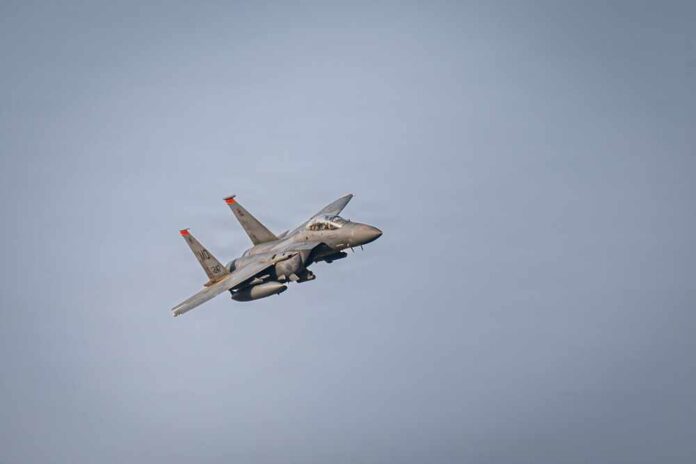
- U.S. officials confirmed an F-15E Strike Eagle was shot down by enemy fire over Iran on Friday, April 3, 2026, the first confirmed manned U.S. aircraft loss to hostile action in this war.
- U.S. forces rescued one of the two crew members; a search-and-rescue operation continued for the second as the day progressed.
- Iranian state-linked outlets publicized debris and claims, including disputed assertions about downing an F-35, while also encouraging efforts to capture the crew.
- The incident adds pressure on the Trump administration as MAGA voters split between backing allies and rejecting another open-ended Middle East conflict.
F-15E shot down over Iran as rescue mission races the clock
U.S. officials told multiple outlets that an F-15E Strike Eagle went down over Iran on Friday during Operation Epic Fury, and that one of the two crew members was rescued by U.S. forces. The search for the second crew member continued into the afternoon, with official public details limited as the operation unfolded. Iranian sources claimed the shoot-down and pushed dramatic versions of events, underscoring how quickly battlefield facts can become political weapons.
Reporting described an immediate, multi-aircraft combat search-and-rescue effort that included refueling support and rescue helicopters operating at low altitude, a profile that increases exposure to ground fire. The basic reality is straightforward: recovering a downed crew in hostile territory is among the riskiest missions the U.S. military executes. When it happens over Iran, with state media and local officials urging civilians to join the hunt, every minute matters.
Iran’s information war: debris, disputed claims, and a bounty narrative
Iranian messaging leaned hard into spectacle—broadcasting images said to be from the crash site and elevating claims about what type of aircraft was hit. U.S.-confirmed reporting identified the aircraft as an F-15E, while Iranian outlets circulated claims involving an F-35 that other reporting treated as disputed. The effect is not just confusion; it is leverage. Capturing U.S. personnel can be used to extract concessions, fuel anti-American theater, and pressure Washington through public humiliation.
Iranian state-linked reporting also referenced calls for residents to search for the crew, with local officials tied to a southwest province pushing a bounty-style narrative. That matters because it blurs the line between combatants and civilians, incentivizing vigilantism while raising the risk to any isolated service member on the ground. U.S. forces are trained for these situations, but the constitutional reality at home remains: elected leaders must explain clearly why Americans are being placed in these high-risk scenarios and what the endpoint is.
What this loss signals about air defenses and U.S. risk tolerance
This shoot-down marks a turning point from earlier episodes in the conflict that involved drones or non-lethal outcomes. Prior reporting in the same war included significant MQ-9 drone losses and a damaged F-35 that made it back to base, plus a separate friendly-fire incident over Kuwait in which all crew survived. Losing a manned jet to enemy fire changes the political calculus because it increases the odds of POW scenarios, U.S. retaliatory strikes, and a ratchet effect that can widen the war.
Domestic politics: MAGA unease with another war meets hard realities abroad
The downing arrives as Trump’s second-term administration owns the consequences of federal war policy in real time. Conservative voters who remember promises to avoid new wars are now watching a conflict that has already produced U.S. casualties and escalating missions inside Iran. That tension is now visible inside the MAGA coalition: some prioritize standing with allies and deterring Iran, while others see a familiar pattern of open-ended conflict, higher energy costs, and Washington drifting toward another intervention without a clear finish line.
Operational security is a legitimate reason officials stay tight-lipped during an ongoing rescue, but strategic clarity is different. If the mission expands, Congress and the public will demand answers on objectives, authorities, costs, and duration—especially from voters who are already fed up with overspending and inflationary pressure at home. The immediate priority remains the missing crew member. The larger test will be whether Washington can define a constitutional, limited, and achievable strategy that doesn’t slide into yet another forever war.
Sources:
US forces rescue downed fighter pilot in Iran; search for second continues
Iran war live updates: Trump warns more coming; oil and gas concerns around Strait of Hormuz