

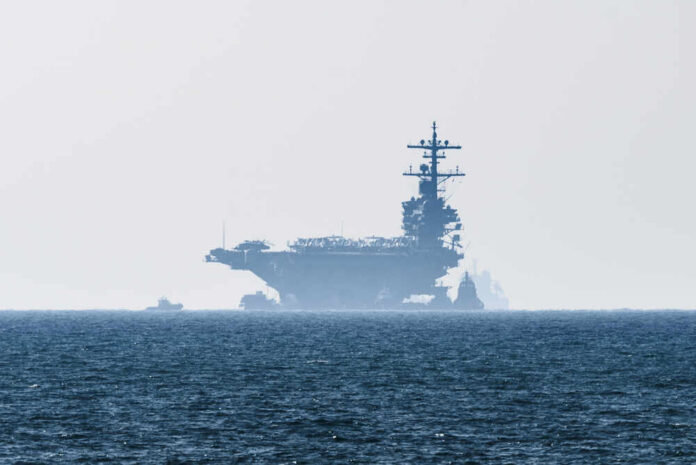
President Trump has ordered the U.S. Navy to blockade every Iranian port following the collapse of ceasefire negotiations, marking the most aggressive economic warfare tactic in the two-month conflict that many fear could spiral into a broader regional catastrophe.
Story Snapshot
- U.S. naval blockade of all Iranian ports began Monday morning after 21 hours of failed ceasefire talks over Iran’s nuclear program
- Trump threatened to destroy any Iranian forces that fire on U.S. ships, escalating tensions after IRGC drones confronted American destroyers clearing mines in the Strait of Hormuz
- The blockade aims to strangle Iran’s oil-dependent economy by halting exports through critical ports like Bandar Abbas
- Experts warn the operation could take months to achieve full economic impact while risking environmental disaster and wider regional war
Diplomatic Collapse Triggers Naval Showdown
The U.S. Central Command announced Monday morning that American naval forces began blockading all Iranian ports and coastal areas, hours after President Trump issued the order via Truth Social. The move followed the weekend collapse of ceasefire negotiations in Islamabad, where 21 hours of talks ended without agreement. Vice President JD Vance confirmed the primary sticking point involved U.S. demands regarding Iran’s nuclear program, which Tehran deemed unreasonable. The failed diplomacy represents a critical turning point in a conflict that erupted in February 2026 when Iran blockaded the Strait of Hormuz with mines.
Mine-Clearing Operations Meet Armed Resistance
On Saturday, U.S. Navy destroyers USS Frank E. Petersen Jr. and USS Michael Murphy transited the Strait of Hormuz to clear Iranian-laid mines when IRGC forces issued warnings captured on video released by Iranian state media. The footage shows Iranian Revolutionary Guard units ordering American vessels to “go back” with threats of being targeted. U.S. ships reportedly halted their crossing after Iran launched drones, illustrating the dangerous cat-and-mouse game playing out in waters that handle twenty percent of global oil traffic. Trump’s response was characteristically blunt, vowing that any Iranian who fires on American forces “will be BLOWN TO HELL.”
Economic Stranglehold Targets Iran’s Lifeline
The blockade strategy deliberately targets what analysts call the “jugular” of Iran’s oil-dependent economy by preventing exports and imports through ports critical to Tehran’s revenue stream. Unlike earlier threats to completely shut down the Strait of Hormuz, this approach focuses specifically on Iranian coastal facilities while working to clear mines that would allow normal shipping for other nations. Military experts acknowledge the U.S. Navy possesses the capability to enforce such operations against large oil tankers, though they caution it remains a challenging mission requiring sustained commitment. Roger Altman of Evercore warned that achieving full economic effectiveness could require months, not weeks.
Asymmetric Warfare Raises Stakes for All Sides
While the U.S. holds overwhelming naval superiority, Iran’s Islamic Revolutionary Guard Corps has demonstrated effective asymmetric tactics including mine warfare, drone swarms, and fast-attack boats that pose real threats to American vessels. The IRGC’s previous declarations that Gulf ports would be available “for all or none” signal Tehran’s willingness to escalate rather than capitulate under economic pressure. Regional experts note the risk of environmental catastrophe from damaged tankers or mine explosions, alongside the potential for miscalculation that could expand the conflict beyond the Persian Gulf. European leaders are already positioning themselves for post-conflict security roles, suggesting widespread concern about how this confrontation ends.
Iran’s Next Move Decides Everything: Every Iranian Port Will Be Closed by the U.S. Navy.https://t.co/o13zPS3Kvb
— 19FortyFive (@19_forty_five) April 13, 2026
For Americans across the political spectrum tired of endless overseas conflicts, this escalation raises familiar questions about mission creep and unclear objectives. The blockade may represent decisive action to some and reckless provocation to others, but both perspectives share legitimate concerns about whether Washington has a coherent strategy to end this conflict without catastrophic consequences. With oil markets already volatile and global shipping firms avoiding the Gulf entirely, the economic ripple effects extend far beyond Tehran and Washington to impact everyday Americans facing potential energy price spikes. The next moves by both sides will determine whether this gambit forces Iran to negotiate or instead triggers the wider war that so many fear.
Sources:
Iran Releases Video of Standoff with US Warships in Strait of Hormuz