

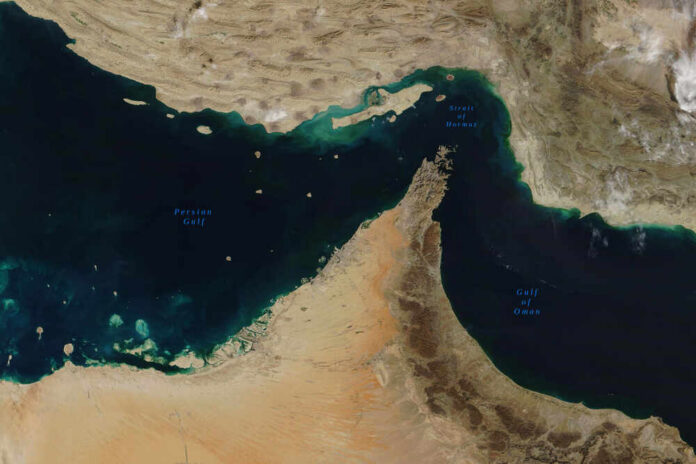
Iran’s latest Strait of Hormuz “reopening” claim comes with a stunning catch: Tehran says it can’t find all the mines it laid—yet it still wants million-dollar tolls to let ships pass.
Quick Take
- U.S. officials say Iran cannot locate and remove every sea mine it deployed in the Strait of Hormuz, leaving a lingering hazard even under a ceasefire.
- Iran is reportedly requiring “arrangements” for transit and charging tolls said to exceed $1 million per ship—effectively turning a global chokepoint into a pay-to-play gate.
- Recent incidents include merchant vessels reportedly hit by “unknown projectiles” and at least one onboard fire that required evacuation, underscoring that “open” does not mean safe.
- The standoff exposes a hard reality for Americans: energy prices and inflation can still be jolted by foreign regimes exploiting U.S. and allied vulnerabilities.
Iran’s “Open Strait” Message Collides With Mine Reality
Reporting that cites U.S. officials says Iran is unable to locate all the mines it laid in the Strait of Hormuz, even as Tehran signals that traffic can resume under a fragile ceasefire. That combination—an announced reopening alongside an admitted inability to fully clear mines—creates a built-in coercion tool. Ships, insurers, and navies must treat the waterway as dangerous until sweeping and verification occur, regardless of political statements.
The Strait of Hormuz is not a niche regional corridor. It is a narrow chokepoint linking the Persian Gulf to the open ocean, and it historically handles a large share of global seaborne oil and liquefied natural gas. When shipping pauses or reroutes, costs rise quickly through fuel markets, insurance premiums, and consumer prices. For U.S. families already wary of inflation, the practical takeaway is simple: global instability still reaches Main Street fast.
How Mines Turn a Ceasefire Into Leverage—and a Toll Booth
Mine warfare works because uncertainty is the weapon. Even a small number of mines—especially when locations are unknown—can deter commercial traffic and force expensive countermeasures. A retired CENTCOM spokesperson described mines as a “nightmare” tool designed to create fear and delay. The reporting also describes Iran imposing arrangements and tolls said to exceed $1 million per vessel, which would allow Tehran to monetize that uncertainty while claiming compliance with reopening demands.
Several key facts remain difficult to independently confirm in real time, including the precise toll amounts and the full inventory of mines. Iran has also denied that there is “irrefutable evidence” it mined the strait, according to separate analysis cited in the research. Still, multiple sources align on the operational result: commercial transit remains limited and risky, and the presence of mines—cleared or not—gives Iran a practical veto over normal shipping patterns.
Escalation Timeline: From Strikes to Shipping Attacks
The current crisis traces back to late February 2026, when the United States and Israel launched a sustained air campaign against Iran and Iran retaliated with missile and drone attacks. According to the compiled timeline, Iran then escalated by warning ships away, attacking merchant vessels, and deploying sea mines. A temporary ceasefire was reached in early April with expectations the strait would reopen, but subsequent days still brought reports of vessels hit by projectiles and a fire onboard at least one ship.
Why This Matters to U.S. Voters Who Think Government Is Failing
For many Americans—right, left, and politically exhausted—this fits a familiar pattern: major institutions promise stability, but ordinary people bear the costs when assumptions collapse. Conservatives will focus on deterrence, energy independence, and the danger of letting hostile regimes dictate terms to global commerce. Liberals often focus on humanitarian fallout and the risk of wider war. Both sides can recognize a shared frustration: strategic weakness and policy drift can turn into higher prices and insecurity at home.
Iranian Regime Claims It Can't Un-Mine Strait of Hormuz, but Needs Tolls Anywayhttps://t.co/V3EAhDgnEA
— PJ Media (@PJMedia_com) April 11, 2026
The next steps will likely revolve around verification and enforcement rather than rhetoric. Mine-clearing is slow, technical, and dangerous work, and the it notes that U.S. mine-countermeasure capacity has been reduced compared with prior eras—an exploitable gap any adversary would notice. President Trump has indicated a willingness to escort ships, while talks are expected to continue amid disputes over what the ceasefire covers. Until credible clearance occurs, “open” may remain more slogan than reality.
Sources:
Iran holds world energy hostage in nightmare Strait of Hormuz sea mines
Iran unable to find all mines it laid in Strait of Hormuz: Report