

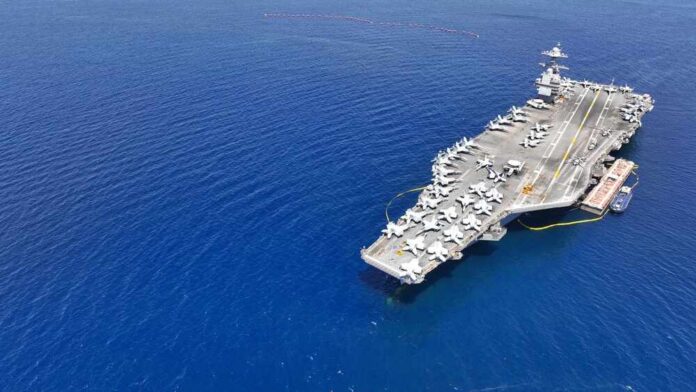
A Navy plan to keep USS Gerald R. Ford at sea for up to 11 months is stretching America’s premier carrier—and its sailors’ families—far past what most taxpayers ever signed up for.
Story Snapshot
- USS Gerald R. Ford’s current deployment is on track to approach 11 months, nearing post‑Vietnam records.
- Dynamic tasking from the Mediterranean to the Caribbean and back shows rising global demands on a strained fleet.
- Extended deployments stress sailors, families, and maintenance schedules, with long‑term retention risks.
- Trump’s Pentagon must decide whether to normalize these record tours or restore predictable, family‑friendly rotations.
Ford’s Record‑Stretching Deployment Puts Families to the Test
When USS Gerald R. Ford left Norfolk on June 24, 2025, most families expected a standard six‑to‑eight‑month cruise, the norm for modern carrier deployments. Instead, as the ship pushes beyond eight months and marches toward a potential 11‑month tour, more than 5,000 sailors and thousands of air wing personnel are living through one of the longest post‑Vietnam carrier deployments. For conservative families who proudly send sons and daughters to serve, promises of stability now feel increasingly fragile.
The Ford strike group’s schedule has been anything but routine. After early months in the Atlantic and Mediterranean, the carrier shifted west through the Strait of Gibraltar in November 2025 to support missions under U.S. Southern Command in the Caribbean. By mid‑February 2026, it had crossed the Atlantic again, re‑entering the Mediterranean at a time when NATO exercises and regional flashpoints demanded a visible American flag. Each new tasking quietly pushed the homecoming date further to the right.
From Trump’s Commissioning to Today’s Demands on the Fleet
USS Gerald R. Ford is no ordinary ship; it is the lead vessel of America’s newest class of supercarriers, commissioned on July 22, 2017, with President Donald J. Trump presiding over its entry into service. After an initial technology‑focused “service‑retained” cruise in late 2022, Ford executed a full eight‑month deployment from May 2023 to January 2024, proving its advanced flight deck systems, electromagnetic catapults, and high‑tempo sortie capability in the Atlantic and Mediterranean alongside NATO partners.
Those earlier deployments were designed around the Optimized Fleet Response Plan, the model supposed to balance maintenance, training, and operations through predictable six‑to‑eight‑month tours. Ford’s current deployment breaks that mold. If the ship remains at sea beyond mid‑April 2026, it will surpass the roughly 294‑day benchmark for extended carrier cruises established in the post‑Vietnam era. An 11‑month run would mean roughly 330 days deployed, raising hard questions about whether the Navy is back‑sliding into the kind of “forever deployment” pattern many thought was left behind with the worst of the Global War on Terror.
Readiness, Retention, and the Human Cost of ‘Do More with Less’
On paper, Ford’s record shows a platform built to endure long stretches at sea. During the 2023‑2024 deployment, the strike group spent 239 days underway, executed 43 replenishments at sea, flew over 17,000 flight hours, and sailed more than 83,000 nautical miles without major mishap. Those numbers prove what American engineering and training can do. They do not, however, erase the human cost of nearly a year away from spouses, children, and aging parents who bear the unseen burden of an overstretched fleet.
Long deployments hit particularly hard in conservative, military‑heavy communities around Norfolk and across the South, where service is often a family tradition and patriotism runs deep. When carriers stay out months beyond expectations, reenlistment decisions shift, young sailors reconsider futures in uniform, and small businesses built around predictable homeport cycles suffer. For a Trump‑era Pentagon focused on rebuilding readiness after years of woke priorities and budget gamesmanship, allowing extended tours to become the “new normal” risks hollowing out the force from within.
Strategic Presence vs. Sustainable Power Projection
Navy leaders argue that Ford’s extended cruise showcases American resolve and flexibility at a moment of global uncertainty, from Europe’s periphery to the Caribbean. The ship’s ability to pivot across combatant commands—supporting NATO in the Mediterranean, then countering instability and illicit trafficking in the Caribbean, then returning east again—underscores how few carriers the United States has available at any given time. Each additional mission loaded onto Ford reflects a world that grew more dangerous under previous weak leadership and globalist drift.
Navy’s Kilby signals USS Ford could see 11-month deployment, approaching record length https://t.co/vCgJ7sb66z
— Breaking Defense (@BreakingDefense) March 5, 2026
Yet strategic presence must be matched by a deployment model that respects both hardware limits and human endurance. Every extra month at sea means deferred maintenance at Newport News Shipbuilding and delayed upgrades that keep this Trump‑era flagship ahead of China’s rapidly expanding navy. Every skipped homecoming ceremony sends a quiet message to allies and adversaries alike about a fleet being asked to do too much with too little. A conservative approach to national defense demands not just more ships, but smarter, constitutionally grounded use of the ones we have.
Sources:
USS GERALD R. FORD (CVN 78) history – Navysite.de
Making history on USS Gerald R. Ford as deployment nears – STRATCOM.mil
Gerald R. Ford Carrier Strike Group returns from historic deployment – Navy.mil
Ford Nears Record Deployment as Navy Signals Readiness for Longer Cruises – Military.com
USS Gerald R. Ford CVN‑78 – Seaforces.org
USS Gerald R. Ford (CVN‑78) – Deployment History – USCarriers.net