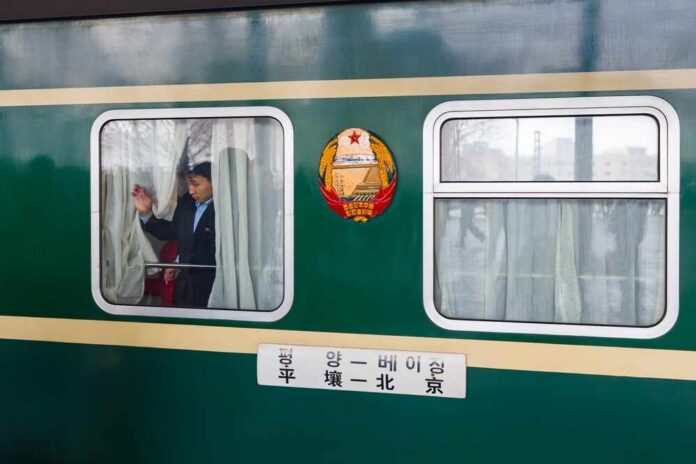
China ramps up its alliance with nuclear-armed North Korea through resumed passenger trains, sending a clear signal to President Trump’s America First agenda amid rising superpower tensions.
Story Snapshot
- Passenger trains between Beijing and Pyongyang resume March 12, 2026, after six-year COVID suspension, initially for diplomats and officials.
- Four weekly round trips operated by China State Railway Group strengthen China’s grip on its key ally North Korea.
- Timing aligns with China’s Two Sessions and potential U.S.-China summit, showcasing Xi Jinping’s peripheral diplomacy.
- North Korea’s economy eyes tourism revival, dominated by Chinese visitors pre-pandemic, despite tight border controls.
Train Resumption Details
China State Railway Group announced passenger services restart on March 12, 2026, with trains departing Beijing at 5:26 p.m. and arriving in Pyongyang around 6 p.m. the next day. Four round trips run weekly on Mondays, Wednesdays, Thursdays, and Saturdays. Initially, the last two carriages serve diplomats and official travelers only. South Korea’s Unification Ministry confirmed the schedule on March 10, 2026. This marks the first full passenger service since January 2020 border closures.
Historical Suspension and Recent Catalysts
Services halted in January 2020 due to COVID-19, despite China’s 2023 lockdown lift allowing partial freight resumption. Passenger links stayed suspended until a September 2025 North Korea-China summit in Beijing prompted upgrades, including a new international passenger waiting hall at Dandong Station. Photos of railway notices surfaced on March 10, 2026, verifying readiness. North Korea canceled its April 2026 Pyongyang Marathon, signaling limited broader tourism openings.
Strategic Motivations Behind the Move
China leverages the rail link to demonstrate influence over North Korea, its largest trading partner and primary tourism source pre-2020. The timing precedes China’s Two Sessions and a potential U.S.-China summit, emphasizing peripheral diplomacy. North Korean authorities, including the Railways Ministry, coordinate resumption tied to summit outcomes. Decision-makers like Xi Jinping and Kim Jong Un prioritize official exchanges, with potential spillover to public travel if seats remain.
Power dynamics favor China as North Korea’s economic dominant ally, strengthened by 2025 bilateral ties. Rail operators focus on diplomats first, reflecting tight North Korean border controls that limit tourism to restricted groups like Russians.
China-North Korea trains to resume after six-year halt pic.twitter.com/gywYUoYyME
— AlexandruC4 (@AlexandruC4) March 10, 2026
Impacts on Economies and Geopolitics
Short-term boosts occur for official exchanges and Chinese border regions like Dandong through revived activity. Long-term, personnel flows expand, reactivating pre-2020 tourism patterns. Economically, trade channels normalize; politically, China signals intact North Korea ties ahead of U.S. negotiations. Experts from Kyodo News anticipate even more active relations as this key conduit resumes. Uncertainties persist on public ticket sales and passenger volumes.
Under President Trump, this development underscores challenges to America First policies, as China-North Korea coordination grows without U.S. concessions. Conservatives wary of globalist entanglements view strengthened communist alliances as a direct threat to Western security interests.
Sources:
North Korea and China to Resume Passenger Train Service After Six-Year Gap
China-North Korea passenger train services to resume from March 12 after 6-year hiatus
NKNews photos confirm railway notices
Train services between Pyongyang and Beijing to resume for 1st time since Covid-19 pandemic