

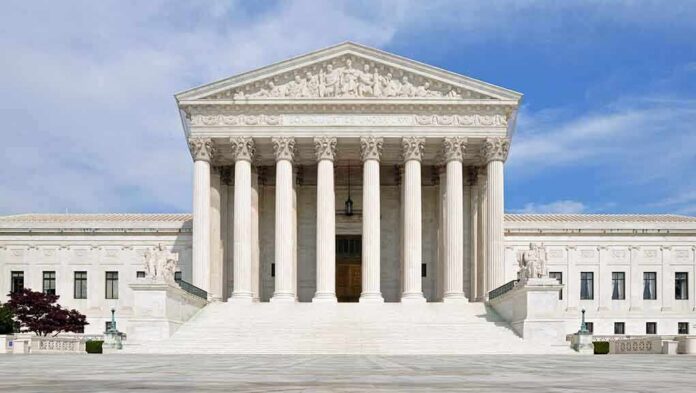
America’s highest court just cleared the way to strip deportation protection from Haitians and Syrians, raising hard questions about security, sovereignty, and basic fairness in our immigration system.
Story Snapshot
- Supreme Court’s 6–3 ruling lets the Trump administration end Temporary Protected Status (TPS) for Haiti and Syria, shifting power firmly back to the executive branch.[3]
- Hundreds of thousands of long‑time residents now face losing legal status and work permits, with many at real risk if forced to return.[1][6]
- Advocates cite a State Department “Do Not Travel” warning for Haiti and ongoing gang violence to argue that deportations are dangerous and wrong.[1][8]
- Conservatives see the ruling as a needed reset: Congress wrote TPS as temporary, not a back‑door, permanent amnesty program.[7]
Supreme Court Says TPS Really Is Temporary
The Supreme Court’s ruling on Temporary Protected Status for Haiti and Syria centers on a simple point: who decides when “temporary” protections end.[3] The Court held that the immigration law creating TPS does not let federal judges second‑guess these decisions, unless there is a live constitutional issue such as clear proof of discrimination.[5] That puts power back where Congress first placed it, with the president and the Secretary of Homeland Security, instead of with unelected judges in distant courtrooms.[7]
For many conservative readers, that outcome defends basic separation of powers and reins in years of bench‑driven immigration policy.
What Ending TPS Means for Haitian and Syrian Families
Temporary Protected Status was meant for people who were already here when disaster struck their home country.[2] It lets them stay and work lawfully until conditions improve. Under Trump’s second term, the Department of Homeland Security, led by Secretary Kristi Noem, moved to terminate TPS for Haiti and Syria, saying both countries no longer meet the legal standard.[3] That decision affects roughly 350,000 Haitian and Syrian TPS holders, many of whom have lived in the United States for a decade or more, built families, and bought homes.[1] When TPS ends, they lose work permits and become deportable, unless they qualify for another form of legal status.[7]
Advocates warn this will tear apart mixed‑status families and drain local economies where TPS holders are key workers.[1] Business owners in cities like Miami and New York say many TPS holders staff hospitals, construction sites, and small shops.[6] Faith leaders and civil‑rights attorneys also argue that pushing people out now, after they followed the rules and paid taxes, violates basic fairness, even if Congress wrote TPS as temporary.[20] Their protests do not change the legal bottom line, but they highlight the real human cost of any major shift in immigration policy.
Is Haiti Safe Enough to Send People Back?
The sharpest dispute is over Haiti. The U.S. State Department still posts its highest Level 4 “Do Not Travel” advisory for Haiti, warning of crime, kidnapping, unrest, and a national state of emergency in place since 2024.[8][1] That advisory says the government cannot reliably protect American citizens there and notes a risk of stray bullets even for people not involved in the violence.[1] Haitian‑American groups point to this language and ask how it can be “unsafe” for tourists but somehow “safe” for mass deportations of families who have not lived there for years.[2]
Critics say the administration’s own records admit Haiti is unstable but claim it is in the “national interest” to end TPS anyway.[1] They argue this flips the original purpose of TPS, which was to keep people from being sent back into chaos. At protests in Miami, some organizers even called forced return a “death sentence,” citing gang rule and collapsed services on the ground.[10] Supporters of the Trump policy answer that travel advisories are written for short‑term visitors, not for citizens returning home, and that the United States cannot keep extending emergency status forever without breaking the statute.[7]
Security, Sovereignty, and Claims of Racial Bias
The Court majority firmly rejected the claim that race drove the Haiti decision, finding the challengers unlikely to prove that racial animus was a motivating factor.[3] That stands against years of lawsuits that painted Trump‑era TPS changes as “racism masking as immigration policy” and cited ugly comments about migrants from poor countries.[19][20] Justice Elena Kagan’s dissent pointed to public statements about Haitians by Trump and top officials and argued that the “plain to see” record showed hostility toward Black and non‑European immigrants.[12][16] But her view did not carry the day, and the legal standard for proving such bias remains very high.
For conservatives, the focus is different. Many see TPS fights as part of a broader pattern where activists try to turn short‑term humanitarian programs into permanent pipelines.[6] The Trump team argues that every extension without end invites more illegal immigration in the hope of future amnesty.[16] Ending TPS for countries long past the original disaster is framed as a necessary step to restore the rule of law, secure the border, and stop using emergency tools to dodge Congress.[7] That message resonates with voters tired of open‑ended spending, crowded schools and hospitals, and years of vague promises about “reform” that never materialize.
What Comes Next for Policy and for Families
The ruling does not force immediate deportations, but it does clear the legal road for them once termination dates arrive.[4] Some lower‑court judges had called earlier TPS cuts “arbitrary and capricious” for ignoring evidence of danger in places like Haiti.[7][15] Those stays are now vulnerable, and the administration holds the cards. Congress could step in with new laws to narrow executive power or offer one‑time paths to permanent status, but that would require bipartisan agreement that has been missing for years.[18]
For readers who care about both border security and basic decency, the stakes are high. On one side is a real need to stop using “temporary” tools as permanent back doors and to defend the constitutional role of the elected branches. On the other side are neighbors who have followed the rules under TPS and now face return to countries our own government still warns are dangerous. The Supreme Court has spoken on the law; what we do next as a country will say far more about our values.
Sources:
[1] YouTube – What ending deportation protection means for thousands
[2] Web – What ending deportation protection means for thousands of Haitians …
[3] Web – Supreme Court to weigh Trump’s bid to end deportation shield for Haiti …
[4] Web – What the Supreme Court’s TPS Ruling Means for Haitians and Syrians
[5] Web – Supreme Court lets Trump strip deportation protections from Syrians …
[6] YouTube – TPS for Haitians and Syrians Hangs in the Balance
[7] YouTube – What ending US deportation protection means for Haitians, Syrians
[8] Web – United States: Supreme Court Allows Termination of TPS for Haiti and …
[10] Web – Court rulings put deportation protections for Haitians, Syrians …
[12] Web – Extension of Syria TPS insufficient
[15] Web – Haitians and Syrians aren’t only immigrants watching Supreme Court …
[16] Web – Did President Trump Attempt…
[18] Web – [PDF] Supreme Court of the United States
[19] Web – 2025 NTPSA v. Noem I (Haiti and Venezuela)Lawsuit Information
[20] Web – Mullin v. Doe | Supreme Court Bulletin | LII / Legal Information …