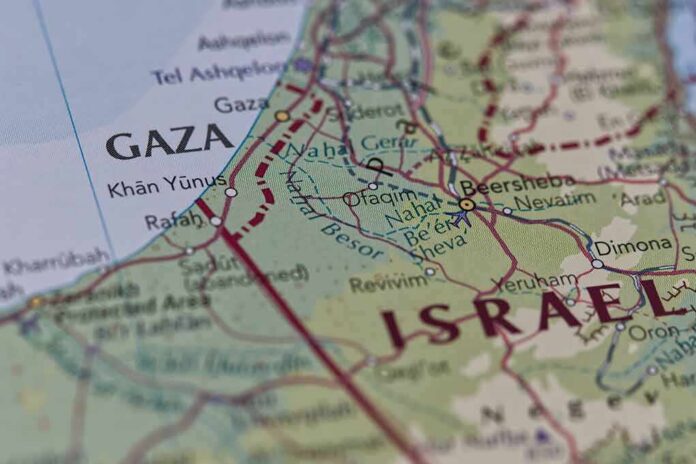
Israel now controls nearly 70% of Gaza — and its own officials say that number will keep growing.
Story Snapshot
- Prime Minister Benjamin Netanyahu personally ordered the Israeli military to expand control to 70% of Gaza, saying “My directive is to move to 70%.”
- Israeli forces held about 53% of Gaza after the U.S.-brokered ceasefire took effect in October 2025. They now control close to 70% — and officials say that figure may rise further.
- Defense Minister Israel Katz stated Israel intends a “permanent military presence” in Gaza, not a temporary operation.
- The expansion puts pressure on Hamas but also strains the ceasefire framework and draws sharp international criticism.
Netanyahu’s 70% Directive
At a conference in the Jordan Valley in late May 2026, Israeli Prime Minister Benjamin Netanyahu made his goal plain. “My directive is to move to 70% control of the Gaza Strip,” he said. Senior military officials then briefed the Israeli Security Cabinet that forces had reached between 67% and 70% of the territory. Netanyahu described the strategy simply: “We are currently squeezing Hamas.” The push began after the U.S.-brokered ceasefire took effect in October 2025, when Israel held roughly 53% of Gaza along what was called the “yellow line.”
Since that ceasefire, Israeli forces have pushed steadily deeper into the strip. By early July 2026, the military controlled nearly 70% of Gaza, including the area of al-Shujaiya. Defense officials told reporters the controlled area could expand further in the months ahead. Netanyahu reiterated the goal at a weekly Cabinet meeting in early June, confirming Israel would “soon control 70%” of the territory. The step-by-step advance has been deliberate and documented across multiple Israeli government statements.
A Long-Term Strategy, Not Just a Military Move
Israeli Defense Minister Israel Katz has been direct about what this means. He declared the goal is a “permanent military presence rather than temporary incursions” and said Israel will “never leave all of Gaza.” Netanyahu reinforced that message in a video released on social media, stating, “There will not be an in-and-out” and “The intention is the opposite.” These statements make clear that Israeli leadership views the current expansion as an enduring posture, not a short-term security sweep.
Israel has also approved a plan to take control of Gaza City and relocate its roughly one million residents southward. The plan, sanctioned by the Israeli security cabinet, includes creating an alternative administration and establishing permanent security control over the region. Reports also indicate Israel is converting the temporary yellow line into a physical border — without any withdrawal mechanism built in. New maps quietly issued by Israel in April 2026 placed thousands of displaced Palestinians inside an expanded restricted zone, with boundaries the military says it can continue to change.
Where the U.S. Fits In — and What Comes Next
The original ceasefire was a U.S.-brokered deal. Under the Trump plan, Israeli forces initially pulled back to the yellow line, leaving Israel in control of about 53% of Gaza. Israel’s continued expansion beyond that line has raised questions about where the Trump administration stands. The U.S. has not publicly forced a halt to the advance, and Netanyahu has continued to push forward. The situation leaves American diplomacy in a complicated spot as Israel’s footprint grows well past what the ceasefire originally envisioned.
From a conservative standpoint, the core tension here is real: Israel has a legitimate security interest in keeping Hamas from rebuilding and launching more attacks. The October 7, 2023 massacre showed what happens when Hamas is left unchecked. At the same time, a declared strategy of permanent military control over 70% — or more — of Gaza is a major commitment with serious long-term consequences. American taxpayers and policymakers have a stake in understanding what Israel’s endgame actually looks like, and whether it aligns with U.S. interests in the region. Those are fair questions to ask of any ally.
Sources:
original.antiwar.com, youtube.com, jpost.com, english.wafa.ps, rte.ie, jns.org, aa.com.tr, aljazeera.com, pdfs.semanticscholar.org