

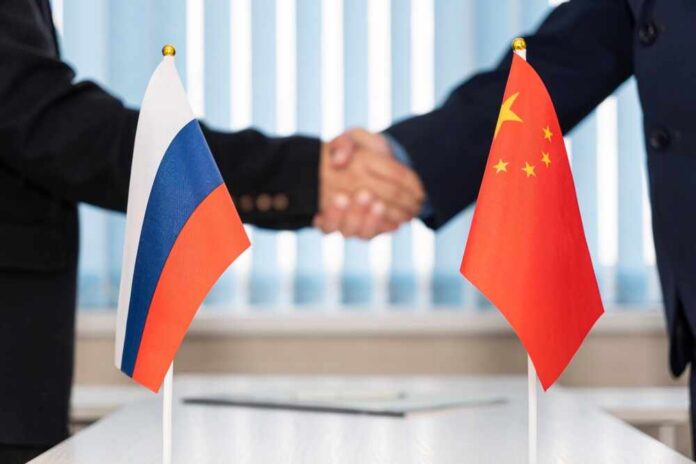
China’s SHOCKING War Game with Russia
China’s pledge of humanitarian aid to Ukraine masks Beijing’s systematic billion-dollar lifeline to Russia’s war machine, exposing a duplicitous strategy that threatens global stability while the Trump administration confronts this dangerous alliance head-on.
Story Snapshot
- China commits humanitarian energy assistance to Ukraine while simultaneously providing $10.3 billion in hypersonic missile technology to Russia
- US intelligence reveals over 130 Chinese firms supply critical dual-use components enabling Russia’s continued strikes on Ukrainian civilians
- Beijing’s “no limits” partnership with Moscow intensified from three to five joint military exercises annually since the invasion began
- Ukraine alleges Chinese satellite intelligence directly aids Russian targeting of infrastructure while China denies any military support
Beijing’s Double Game Exposed
Ukraine’s Foreign Minister Andriy Sybiha announced in early 2026 that China would supply humanitarian energy assistance to address infrastructure devastation from Russian attacks. This pledge arrived just weeks after US intelligence documented Beijing’s transfer of $10.3 billion in advanced hypersonic missile technology to Moscow on January 29, 2026. The stark contradiction reveals China’s calculated approach: project neutrality through token gestures while substantively fueling Russia’s war capacity. This duplicity undermines American efforts to isolate Putin’s regime and exposes the weakness of Biden-era policies that allowed this axis to flourish unchecked.
CHINA 🇨🇳 to provide energy aid package for Ukraine 🇺🇦
The first package includes 109 generators, 19 heating stations and 13 units of emergency equipment, as well as components to repair damaged energy infrastructure.
Is this humanitarian aid or a piece in a global power puzzle? pic.twitter.com/OPuA6OOkVr
— Joel The Dane 🇩🇰🇺🇦 Данський Козак #NAFO (@JoelTheDane) February 17, 2026
The “No Limits” Alliance in Action
China’s strategic support for Russia traces to the February 4, 2022, “no limits” partnership declaration, unveiled just weeks before Putin’s invasion. Since then, Beijing has systematically enabled Russia’s sanctions evasion through renminbi-based trade settlements and intensified military cooperation, increasing joint exercises from three annually pre-invasion to five post-2022. Western sanctions targeted over 130 Chinese companies selling critical chips and dual-use technology to Russia by October 2024, yet the flow continues. Wang Yi admitted in July 2025 that China opposes a Russian defeat, fearing such an outcome would redirect American focus toward Taiwan—a rare moment of honesty revealing Beijing’s true calculus prioritizes weakening the United States over any humanitarian concerns.
Ukraine Caught Between Promises and Reality
Ukrainian President Zelenskyy criticized China’s earlier “peace plans” as destructive, noting they required keeping Russia at the negotiating table regardless of Moscow’s aggression. By October 2025, Ukraine alleged Chinese satellite data directly enabled Russian targeting of energy infrastructure, accusations Beijing denies while continuing diplomatic engagement. China appointed an ambassador to Ukraine in December 2024 and arranged meetings between Wang Yi and Foreign Minister Sybiha at the February 2025 Munich Security Conference. These diplomatic maneuvers create cover for Beijing’s substantive military-economic support to Russia, valued at sustaining Putin’s war machine through components for missiles, drones, and advanced weaponry systems bypassing Western export controls.
Strategic Implications for American Interests
The China-Russia axis demonstrates resilience that directly challenges American global leadership and constitutional principles of sovereignty. Beijing’s dual-track approach—humanitarian gestures masking military enablement—exploits European economic dependencies while positioning China for post-conflict reconstruction influence in Ukraine, estimated at 506 billion euros over ten years. This calculated hedging allows Xi Jinping to maintain economic ties with Europe while building an anti-American coalition with Moscow. The Trump administration now confronts what the Biden years allowed to metastasize: a partnership where China provides technology, economic lifelines, and diplomatic cover enabling Russia’s protracted assault on a sovereign nation, setting dangerous precedents for Taiwan and undermining the rules-based order Americans fought to establish.
The Path Forward Under Trump Leadership
President Trump’s 2026 administration faces the consequences of years of weak Western responses to Beijing’s duplicity. China’s ambassador to Kyiv pushed ceasefire proposals in September 2025 that would freeze territorial gains, rewarding Russian aggression—tactics familiar from China’s own expansionist playbook in the South China Sea. Effective countermeasures require exposing Beijing’s false neutrality, expanding sanctions on Chinese enablers of Russia’s war machine, and rallying allies to demand accountability. Ukraine’s energy aid announcement, while potentially helpful for civilians, cannot obscure the billions in military technology flowing from Chinese manufacturers to Russian strike systems. American leadership must prioritize transparency about this axis, leverage economic power to impose real costs on Beijing, and prevent the normalization of China’s strategy of speaking peace while arming aggressors.
Sources:
Three years of war in Ukraine: the Chinese-Russian alliance passes the test
China and the Russo-Ukrainian war
China’s Position on Russia’s Invasion of Ukraine
China to Supply Ukraine with Humanitarian Energy Assistance
Interests First: China’s Playbook for Post-Conflict Reconstruction and Implications for Ukraine
Engaging Beijing on Peace Strategies for Ukraine