
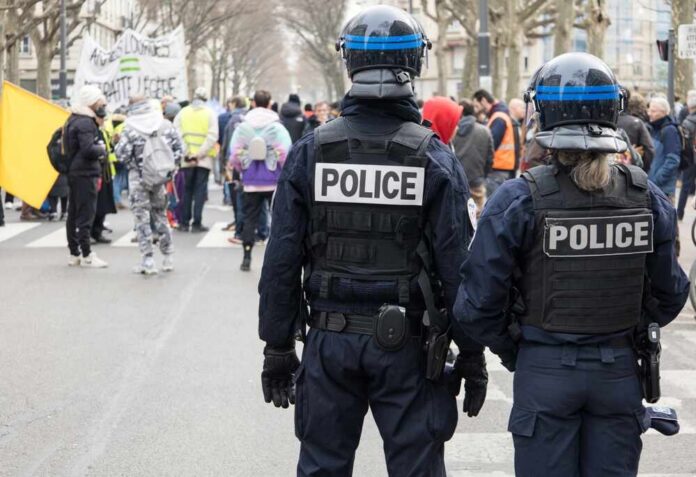
Thousands March Amid Lyon Drone Surveillance
A young activist is dead after street violence erupts around a university event in Lyon—forcing France to confront whether politics is sliding into organized intimidation.
Quick Take
- Quentin Deranque, 23, died from head injuries after clashes between far-right and far-left activists near a university protest in Lyon.
- The confrontation erupted around a scheduled appearance by hard-left lawmaker Rima Hassan, a frequent target of far-right opposition.
- French prosecutors filed preliminary charges against seven suspects, including one person accused of complicity.
- A tribute march drew at least 3,200 attendees under heavy police security, including drones, as authorities feared further clashes.
- President Emmanuel Macron called for calm while signaling a review of violent activist groups with political links—raising questions about enforcement and civil liberties.
Death at the Center of a Campus Flashpoint
Quentin Deranque, a 23-year-old far-right activist, died in mid-February 2026 after suffering severe head injuries during violent clashes on the sidelines of a university demonstration in Lyon. Reports describe the violence as breaking out around protests tied to an appearance by Rima Hassan, a French-Palestinian politician from the hard-left La France Insoumise (LFI) party. The available reporting confirms the cause of death and the political context, while courtroom-level responsibility remains unresolved.
The dispute centered on Hassan’s scheduled participation in a university student meeting, an event that drew opposition from far-right activists and counter-mobilization from far-left militants. Lyon is not a random backdrop: reporting citing French intelligence describes the city as a long-standing hub of far-right activism, with newer far-left militant groups forming in reaction. That combination—campus politics, organized street groups, and a polarized national climate—created conditions where one clash could quickly turn deadly.
Charges Filed as Officials Warn of Organized Political Violence
French authorities moved quickly into the criminal phase. The Lyon prosecutor’s office filed preliminary charges against seven people: six faced charges including intentional homicide, aggravated violence, and criminal conspiracy, while a seventh was charged with complicity. Reporting also states that one suspect is a parliamentary aide connected to an LFI lawmaker who established the anti-fascist group Jeune Garde. Those details add political sensitivity, but the case remains under investigation and will ultimately turn on evidence tested in court.
President Emmanuel Macron publicly urged calm while framing the killing as a moment requiring “firmness and responsibility,” and he announced plans for a ministerial meeting to review violent activist groups with links to political parties. That proposal, on its face, reflects a state trying to reassert basic public order. The open question is how France can crack down on violence and criminal conspiracy without sliding into selective enforcement that treats protest as a crime while letting politically connected militants slip through.
Thousands March, Police Deploy Drones, and the State Refuses a Ban
On February 21, a tribute march in Lyon drew at least 3,200 attendees and unfolded under heavy police security, including drone surveillance. Accounts from the scene describe participants carrying flowers and signs bearing Deranque’s photo, with slogans such as “justice for Quentin” and “the extreme left kills.” Some demonstrators wore black clothing and some covered their faces. Local residents reportedly took precautions, underscoring how political street conflict can spill into everyday life.
Interior Minister Laurent Nunez declined to ban the rally, saying he needed to balance public order with freedom of expression. Lyon’s left-wing Green mayor, Grégory Doucet, and LFI coordinator Manuel Bompard had called for the state to prohibit it. That decision matters beyond France: Western governments often claim they can preserve free speech while controlling unrest, yet bans are typically demanded when the speaker or crowd is politically disfavored. Here, officials opted to police the event rather than outlaw it outright.
Election Pressure and the Risk of Normalizing Street Power
French politics is already positioning for municipal elections in March 2026 and the 2027 presidential contest, and the killing is becoming a rallying point. Reports describe right-wing figures using the incident to attack LFI, while other political actors focus on preventing escalation and maintaining legitimacy. Former President François Hollande criticized the mainstream left for potentially aligning with Mélenchon’s party in future elections, signaling fractures that could reshape coalition choices and campaign strategy.
Némésis est une bande de fieffées salopes d'extrême droite qui instrumentalise la cause des violences faites aux femmes pour répandre leur haine fasciste. Elles ont une part de responsabilité énorme dans la mort de Quentin Deranque. ⚖️ https://t.co/7nJ1tVapBP
— Soeur Foune (@SoeurFoune) February 23, 2026
For American readers watching from 2026, the lesson is not about importing French politics—it’s about recognizing a pattern many democracies face. When organized factions treat campuses and city streets as battlegrounds, regular citizens lose the ability to speak, assemble, or raise families in peace. The reporting supports one clear conclusion: France is struggling to keep political conflict inside lawful boundaries, and the outcome will hinge on whether authorities punish violence consistently—without granting ideological exemptions.
Sources:
https://www.bssnews.net/international/362844