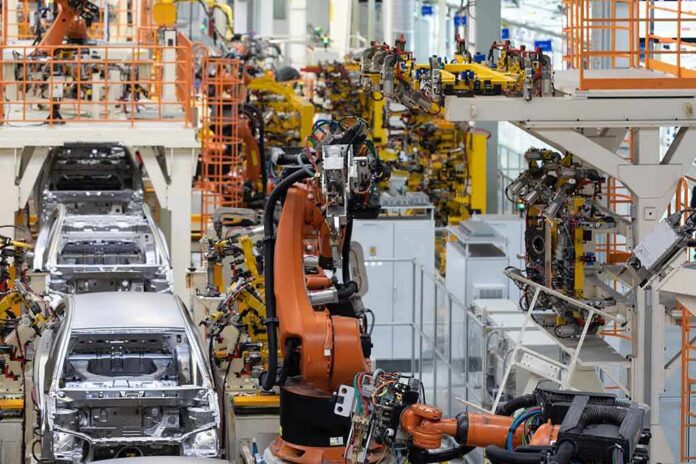
Major carmakers are turning idle auto plants into military production lines to win new contracts as Chinese rivals surge in the civilian market.
Story Highlights
- Ford, General Motors, and Jaguar Land Rover are bidding on a £900 million United Kingdom military vehicle deal using modified trucks and 4x4s.
- Automakers aim to fill underused factories with defense work as civilian sales slow and Chinese competition grows.
- Analysts say defense contracts help jobs and capacity, but will not fix core auto-sector problems by themselves.
- Volkswagen is selling a German plant that will be converted into a defense hub to preserve jobs and output.
Automakers Target Defense Contracts To Use Idle Capacity
Reuters reports that Ford, General Motors, and Jaguar Land Rover are competing for a £900 million United Kingdom Ministry of Defence contract, initially covering 3,000 vehicles, by adapting pickup trucks and off-road models they already build. Executives see defense orders as a practical way to keep factories busy as car demand cools. Companies want steady, government-backed work that can run on existing lines. The effort reflects a hard truth: many Western plants are not full, and managers need volume fast.
Industry coverage describes a broader shift. Western automakers are operating below capacity and face pressure from cheaper Chinese brands, especially in electric models. Defense buyers need rugged vehicles, armored kits, and parts that auto plants can turn out at scale. Using current platforms also helps meet delivery timelines. The strategy is not about glamor projects. It is about loading lines with predictable work that protects jobs, keeps suppliers alive, and buys time to reset product plans.
Chinese Competition And Soft Demand Drive The Pivot
Executives cite two linked forces: weak civilian demand and aggressive Chinese expansion in global markets. Cheaper imports and fast-moving Chinese exporters have squeezed prices and margins. Companies can cut shifts or close plants, or they can seek new customers. Defense ministries offer exactly that. Uniform parts, repeat orders, and multi-year contracts create stability. That stability lets automakers spread fixed costs while they refocus lineups, trim slow sellers, and fight for buyers at home.
Analysts quoted by Reuters caution that military work alone will not turn the tide for the sector’s finances. Defense contracts can keep lines warm and save skilled jobs, but volumes are smaller than mass-market car programs. Leaders still must tackle structural issues: cost gaps, model strategy, and battery supply chains. In short, defense is a bridge, not a cure. It can carry plants over a tough stretch, but it will not replace millions of lost civilian sales on its own.
Europe Moves First: Plant Conversions And Job Protection
Volkswagen agreed to sell its Osnabrueck, Germany, plant to new owners backed by the state of Lower Saxony, who plan to convert it into a defense and security production hub. Labor officials said the deal could preserve most of the site’s jobs. The plan includes an “anchor project” tied to defense systems, showing how governments and industry can team up to protect capacity. The model mirrors past wartime conversions, adapted for today’s needs and supply chains.
Across Europe, reports describe parts makers and vehicle plants repurposing lines for defense programs as orders for cars fade. Europe’s top ammunition producer has shifted auto-parts plants toward defense equipment to meet surging demand. These moves keep skilled workers in place and maintain tooling. They also speed deliveries of needed kit to allies. The approach turns a weakness—idle capacity—into a national strength. It is pragmatic industry policy, not an ideological plan.
United Kingdom Tender Could Reshape Light Military Fleets
The United Kingdom tender for light mobility vehicles aims to replace aging Land Rover-based models with modern, supportable platforms. Bidders propose proven truck and 4×4 bases to control costs and ensure parts access. A modular approach promises faster fielding and easier maintenance. If executed well, troops get cleaner ergonomics, better protection options, and simpler logistics. For automakers, the prize is steady volume and years of service work that keeps factories humming.
From Pickups to Idle Plants: Automakers Seek Lifeline from Defence Boom
The Core Trend
Western automakers are chasing a defence spending boom as a way to sell more vehicles and make use of underemployed factories, though executives say military work will not make up for slowing… pic.twitter.com/hmiuUqAdku— The Cloaked Gaze 👀 (@gaze_observer) September 29, 2026
British and European competitions also matter to American workers. General Motors’ defense division can build components in the United States even when final assembly is overseas, sustaining domestic suppliers. Cross-border programs spread orders across plants and regions. That reduces the risk of a single factory shock. It also supports President Trump’s emphasis on strong industry, secure supply chains, and Western rearmament with shared burden. Jobs, readiness, and capacity move in the same direction here.
What It Means For American Workers And Security
Defense work rewards skills America already has: fast line changeovers, quality control, and complex assembly. These strengths help the United States and allies refill stockpiles and harden supply chains against hostile regimes. The policy lesson is clear. Washington and partners should leverage existing auto capacity where it fits, while keeping procurement tough on cost and delivery. Do that, and taxpayers get value, workers get shifts, and the arsenal of democracy stays open for business.
Sources:
youtube.com, economictimes.indiatimes.com, reuters.com, cbtnews.com