
AI Infrastructure: The $30 Billion Japanese Boost
Japan is putting real money on the table for American industry—just as Washington finally pivots from endless spending at home to rebuilding capacity that actually matters.
Story Snapshot
- President Trump announced the first selected investments tied to Japan’s $550 billion U.S. capital commitment on Feb. 18, 2026.
- The initial tranche focuses on hard infrastructure for growth: AI/data-center power equipment, thermal cooling systems, and major energy commitments.
- White House and Commerce Department fact sheets frame the deal as strengthening U.S. economic and national security interests through supply-chain resilience.
- Japanese officials previously signaled unresolved coordination points, suggesting implementation details are still being worked out.
First Tranche Becomes Real Money, Not Just Headlines
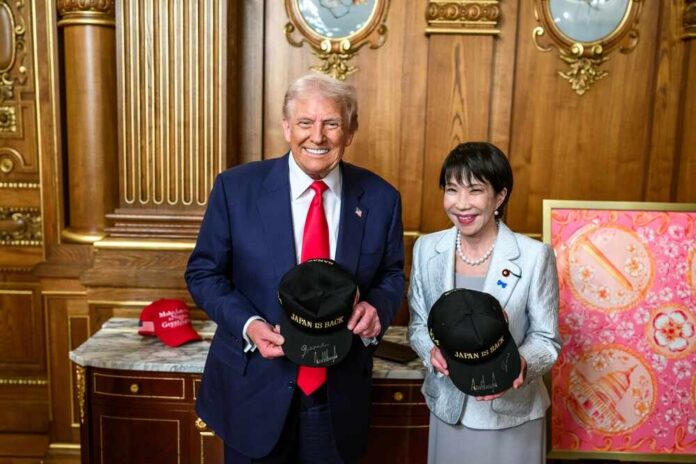
President Donald Trump said Feb. 18, 2026 that Japan is “officially, and financially” moving forward with the first set of investments under a $550 billion commitment to invest in the United States. Reporting on the announcement described three major projects being selected, marking the first concrete deployment under the broader U.S.-Japan framework. The key takeaway for Americans is simple: this moves from diplomatic press releases to specific commitments tied to U.S. industry.
The available public detail still reads more like sector-based allocations than neatly boxed “projects,” which is an important limitation when assessing what is guaranteed versus what is intended. Even so, the fact sheets and corporate pairings identify where the money is supposed to land: equipment, components, and energy supply chains that directly support manufacturing, data centers, and grid reliability. That practical focus contrasts with the recent era of spending that often felt detached from measurable, on-the-ground production.
What the Investments Target: Cooling, AI Infrastructure, and Energy
The White House fact sheet outlines major commitments in thermal cooling systems—up to $20 billion in partnership with Carrier for chillers, air handling systems, and coolant distribution. That may sound technical, but it matters because data centers and power infrastructure do not run on slogans; they run on equipment that keeps systems stable and operational. For communities that have watched industrial know-how hollow out, investments in physical systems are easier to track than vague “green transition” promises.
On AI and data-center infrastructure, the commitments listed include up to $30 billion with Mitsubishi Electric for power station systems and data-center equipment, up to $25 billion with TDK for advanced electronic components and power modules, and up to $20 billion with Fujikura for optical fiber cables. These are the types of inputs that determine whether the next wave of high-tech buildout happens with secure supply chains—or ends up dependent on fragile overseas routes and geopolitical rivals.
Energy Deals Put Alaska and Louisiana Back in the Conversation
Energy is a centerpiece of the early tranche. The White House describes letters of intent from Tokyo Gas and JERA with Glenfarne for LNG offtake connected to an Alaska pipeline project, pegged at more than 10% of export capacity. JERA also announced a $1.5 billion investment in Louisiana’s Haynesville Shale basin, bringing its total U.S. investments to more than $6 billion. For voters tired of inflation and energy price shocks, expanded supply is not academic.
These commitments also show why energy policy is inseparable from national strength. When reliable fuel and export capacity expand, U.S. leverage rises and price volatility can ease over time. The documents available do not provide a full schedule for when dollars are disbursed or when projects break ground, so the near-term impact will depend on execution. Still, the emphasis on LNG and domestic production aligns with a broader push for energy security rather than mandated scarcity.
Negotiations, Tariffs, and What We Still Don’t Know
The investment framework traces back to a landmark agreement announced in 2025 that paired Japan’s investment commitment with a baseline 15% tariff rate, followed by a Trump executive order implementing the framework. Ahead of the February 2026 announcement, Japan’s trade minister held talks in Washington where officials acknowledged an agreement was not reached and that further coordination points remained. That context matters because big numbers are easy; enforceable timelines and definitions are harder.
Trump announces first Japan investments under trade deal: How it helps US counter China?
READ: https://t.co/FBAPZv97im https://t.co/FBAPZv97im
— WION (@WIONews) February 18, 2026
Independent expert analysis is limited in the material provided; most details come from official U.S. government documents and a major news report. That makes it difficult to quantify job totals, regional winners, or downstream consumer impacts with precision. What can be said, based on the sources, is that the first tranche centers on capital-intensive sectors tied to industry and security. For Americans wary of globalism that ships factories away, the measurable test will be follow-through: contracts signed, facilities built, and supply chains anchored here.
Sources:
Fact Sheet: President Donald J. Trump Drives Forward …
Fact Sheet: US-Japan Trade Deal