
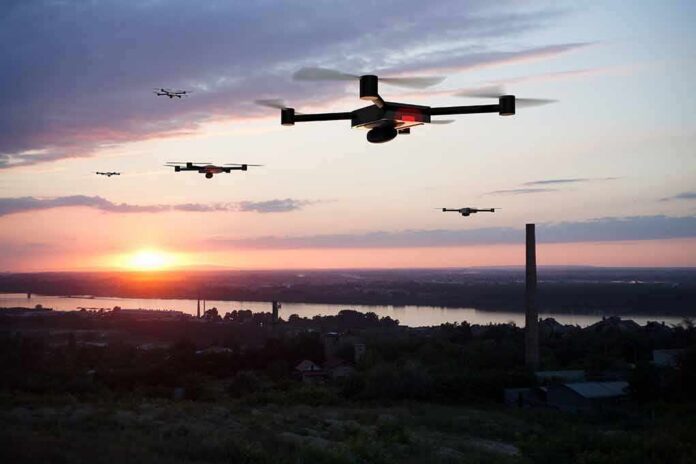
President Trump’s new tariffs of up to 100% on foreign drones move to cut China-linked risk and rebuild U.S. control over a critical technology.
Story Highlights
- Trump signed a proclamation imposing 25% to 100% tariffs on imported drones and key parts, citing national security.
- The policy follows a 2025 executive order to secure the drone supply chain and curb dependence on foreign adversaries.
- Higher rates hit heavy or sensitive drones, while smaller consumer and commercial models face lower tariffs.
- Most tariffs begin September 3, 2026, with some component duties starting in February 2027.
Trump’s Tariffs Target Foreign Control Of U.S. Drone Tech
On August 13, 2026, President Trump signed a formal proclamation to impose new tariffs on imported drones and their components under Section 232 of the Trade Expansion Act, citing national security risks from foreign suppliers. Reports detail rates reaching 100% on sensitive, heavy, or military-adjacent drones, with 25% duties on smaller consumer and commercial models. The move aims to break dependence on foreign electronics, sensors, software, and power systems that underpin many platforms used in the United States.
The White House schedule sets most tariffs to take effect on September 3, 2026, while certain component duties begin on February 9, 2027, giving industry time to adjust. Coverage notes that the highest tariffs fall on drones weighing more than 25 kilograms and systems with thermal imaging or similar sensitive features. The administration frames this as a direct response to security threats and data concerns tied to China-linked supply chains, which have dominated key parts of the market.
Policy Builds On 2025 Order To “Unleash American Drone Dominance”
In June 2025, President Trump signed the “Unleashing American Drone Dominance” executive order. It directed agencies to root out risky foreign vendors, publish a covered foreign entity list, and push secure sourcing for federal and commercial use. That order also pressed the Department of Commerce to start trade actions and rules to protect the supply chain, laying the path for the current tariffs. The new proclamation turns planning into action by using trade tools to back domestic makers and trusted allies.
Legal footing matters. Section 232 allows the President to adjust imports that threaten national security. Courts have upheld this authority, giving the executive room to act when supply chains put security at risk. By using that statute, the administration ties import rules to defense needs, critical infrastructure, and data security in a fast-growing sector. That grounds the policy in both law and a clear security case.
What The Tariffs Actually Do And When They Hit
The proclamation applies tiered duties based on size, capability, and sensitivity. Heavy industrial or military-leaning drones, and their docking stations, face rates up to 100%. Smaller drones without sensitive features face about 25%. The White House says most duties start 21 days after signing, which lands on September 3, 2026. Less sensitive components shift later, six months out, to February 9, 2027. The structure steers buyers toward American and allied sources that meet security rules.
Financial press notes that U.S. drone stocks rose after the announcement, reflecting investor bets that domestic firms will gain share as imports get pricier. Industry watchers also expect supply lines to rewire away from China-linked parts across batteries, motors, sensors, and control systems. Analysts have warned for years that these sub-systems are the choke points where foreign leverage is strongest. The tariff ladder now puts a real cost on that risk.
Security First, With A Practical Path For Industry
The 2025 order started a practical checklist: name suspect suppliers, tighten procurement, and boost homegrown capacity. The 2026 tariffs add teeth. They raise the cost of risky imports and give breathing room for U.S. builders to scale. The later start for some component duties offers time to retool supply lines and avoid sudden shocks that could hit small businesses and public safety users. This is a security-first plan that still gives operators a runway to adapt.
Conservatives will see a familiar pattern. Washington long ignored hollowed-out factories while cheap imports undercut U.S. workers. Drones are now core to farming, energy, policing, and defense. Letting adversary-linked firms own this backbone invites data theft and sabotage. The Trump administration is drawing a firm line: protect the homeland, rebuild industry, and keep critical tech under American control. The facts show a clear policy chain, legal authority, and a timeline that makes sense.
Sources:
whitehouse.gov, wsj.com, finance.yahoo.com, dronelife.com, abcnews.com, cnbc.com, x.com, globenewswire.com, trumpwhitehouse.archives.gov