

EPA’s Bold Move: Climate Policy Uprooted
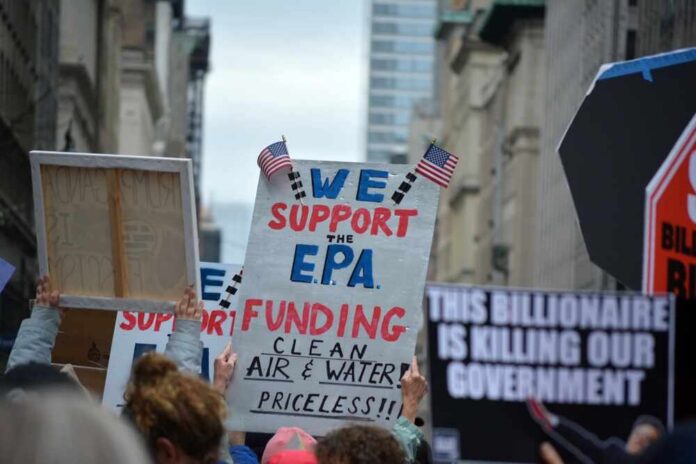
President Trump’s EPA just dismantled the legal foundation enabling decades of federal climate regulations, delivering what energy sector advocates call the most significant deregulatory victory in American history while environmental activists launch urgent legal challenges.
Story Snapshot
- Trump administration revoked the 2009 “endangerment finding” that classified greenhouse gases as pollutants under the Clean Air Act
- EPA Administrator Lee Zeldin hailed the move as ending the “Holy Grail of federal regulatory overreach” that burdened American industry
- The repeal removes legal authority for emission standards on vehicles, power plants, and factories nationwide
- Environmental groups and California immediately filed lawsuits, setting up a Supreme Court showdown
Trump Delivers Historic Regulatory Rollback
On February 12, 2026, the Environmental Protection Agency finalized the repeal of the Obama-era endangerment finding, a 2009 determination that declared carbon dioxide, methane, and four other greenhouse gases dangerous to public health and welfare. President Trump described the action as “the single largest deregulatory action in American history,” marking a fundamental shift away from climate-focused policies that conservatives have long criticized as economically destructive. EPA Administrator Lee Zeldin reinforced this message, calling the original finding the “Holy Grail of federal regulatory overreach” and asserting that greenhouse gas emissions from power plants do not constitute significant pollution threats.
Climate, Energy Experts Shower Praise on Trump's Endangerment Finding Repealhttps://t.co/Gno5jLcqtG
— RedState (@RedState) February 20, 2026
Undoing Two Decades of Climate Bureaucracy
The endangerment finding originated from a 2007 Supreme Court ruling in Massachusetts v. EPA that compelled the agency to evaluate whether greenhouse gases qualify as pollutants under the 1970 Clean Air Act. The Obama administration’s EPA subsequently issued the 2009 finding, creating the regulatory framework for emission standards targeting vehicles, power plants, and industrial facilities. This framework survived legal challenges from the American Petroleum Institute and conservative groups in 2013-14, with courts upholding the science-based determination. Unlike previous Trump-era rollbacks that modified specific regulations, this repeal strikes at the core legal justification for all greenhouse gas controls, potentially invalidating vehicle tailpipe standards and power plant emission limits across the nation.
Energy Sector Relief and Economic Benefits
Conservative energy experts and industry advocates view the repeal as essential relief from regulations that imposed unnecessary costs on American businesses and consumers. The endangerment finding had enabled Biden administration rules mandating stricter vehicle emissions standards and accelerating electric vehicle adoption timelines. By removing this regulatory burden, the Trump EPA simultaneously proposed a two-year delay on Biden-era vehicle emissions requirements, providing automotive manufacturers flexibility to produce more affordable gas-powered vehicles. This approach aligns with conservative principles favoring market-driven solutions over government mandates, allowing energy producers and manufacturers to operate without federal climate dictates that increased production costs and limited consumer choice.
Legal Battles and State Resistance
California Governor Gavin Newsom immediately condemned the repeal and announced his intent to sue on February 12, declaring the Republican Party the “pro-pollution party.” By mid-February, seventeen environmental and health organizations filed a lawsuit in the D.C. Circuit Court of Appeals challenging the EPA’s action. Sierra Club chief climate counsel Joanne Spalding characterized the repeal as “reckless” with “disastrous consequences,” while Earthjustice accused the administration of “sacrificing health and economy for polluters.” These legal challenges will likely reach the Supreme Court, creating uncertainty about the future of emission standards nationwide. The clash reflects the deep political divide over climate policy, with blue states seeking to preserve regulatory authority while the Trump administration prioritizes economic growth and energy independence over climate activism.
The repeal represents a clear rejection of what many conservatives view as climate alarmism that punished American industry while nations like China expanded coal power unchecked. For those frustrated by years of regulations based on disputed climate models, this action demonstrates the Trump administration’s commitment to restoring common-sense governance that prioritizes American jobs and affordable energy over international climate agreements. The legal outcome will determine whether the federal government maintains sweeping authority to regulate carbon dioxide as a pollutant or whether such determinations require clearer congressional authorization, addressing longstanding concerns about executive overreach through administrative agencies.
Sources:
The Trump Administration’s Repeal of the Endangerment Finding – JD Supra
Trump Administration Faces Lawsuit Over Endangerment Finding – CBS News
US EPA Sued Over Illegal Repeal of Climate Protections – Clean Air Task Force
Earthjustice Statement on Endangerment Finding – Earthjustice
Trump EPA Revokes Scientific Finding That Underpinned US Fight Against Climate Change – OPB
Trump’s Repeal of Landmark Climate Ruling: A Strategic Own Goal – Chatham House
Governor Newsom Statement on EPA Endangerment Finding Repeal – California Governor’s Office
Why the US Endangerment Finding Matters – Earth.Org