Republican governors are betting that protecting conservative student clubs in public high schools will expand free speech—but critics warn it looks like the state picking political and religious winners.
Quick Take
- At least eight GOP-led states have announced partnerships supporting Turning Point USA’s “Club America” chapters in public high schools.
- Supporters say the goal is preventing school administrators from blocking conservative student clubs, not forcing schools to create them.
- Teachers unions and civil-liberties groups argue governors are elevating one viewpoint and risking First Amendment and church-state conflicts.
- The push follows the 2025 assassination of TPUSA co-founder Charlie Kirk, which leaders cite as a catalyst for expansion.
Statehouse Support Moves a Campus Fight Into K-12 Schools
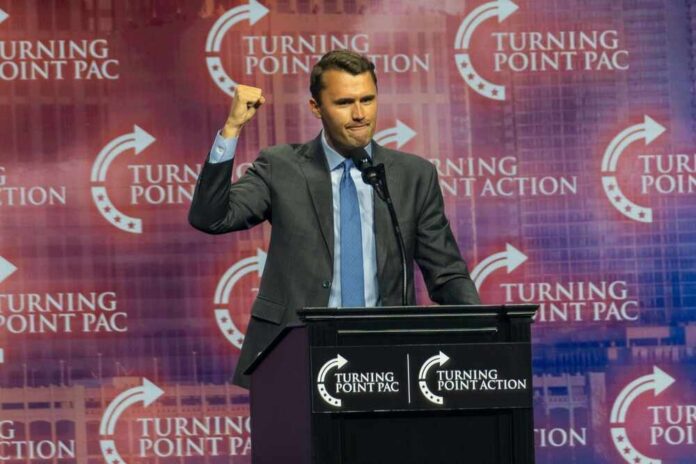
Republican administrations in Nebraska, Arkansas, Texas, Oklahoma, Montana, Florida, Tennessee, and Indiana have recently promoted Turning Point USA’s Club America as a conservative option for students in public high schools. The effort is framed as a response to claims that conservative students face resistance when trying to form clubs. Turning Point USA says it already has roughly 3,400 chapters nationally and that more state partnerships are in the works, signaling an organized expansion beyond college campuses.
Turning Point USA spokesman Matt Shupe has described the partnerships as a way to keep schools from rejecting student-led clubs, emphasizing that states are not “forming” clubs themselves. That distinction matters because public schools typically must treat student groups evenly. Still, when governors publicly champion one organization, critics argue it can look less like neutral enforcement and more like political sponsorship—especially in an education climate already strained by curriculum and speech disputes.
The Equal Access Act Is the Legal Backdrop, But Favoritism Claims Persist
Federal law has long limited public schools’ ability to discriminate against student clubs based on viewpoint, and that’s why the dispute is not simply about whether a conservative club can exist. The sharper question is whether state officials are pressuring schools to treat one outside-backed club as preferred. Nebraska State Education Association president Tim Royers warned that the outrage would be louder if the situation were reversed, arguing the principle should apply consistently, regardless of ideology.
The Associated Press highlights a familiar tension: conservatives often cite viewpoint discrimination in education, while opponents point to GOP-backed restrictions on what teachers can discuss about gender, sexuality, and related topics. It does not quantify how often schools actually block Club America chapters, so the public is left with dueling accounts from students, administrators, and advocacy groups. What is clear is that the fight over “neutral rules” is becoming a fight over who gets official validation.
Religious Rhetoric Raises Church-State Concerns in Public Education
Arkansas Gov. Sarah Huckabee Sanders drew special scrutiny after praising the effort in explicitly religious terms during a March 2026 event, crediting God and linking the push to “faith and freedom.” For supporters, that language fits a broader moral argument about restoring traditional values. For critics, including the ACLU of Arkansas, religious framing by a governor while promoting a specific club inside public schools risks blurring the line between personal belief and state endorsement.
Students are split. Fayetteville High School student Lukas Klaus, described as a TPUSA chapter leader, said some schools have resisted allowing chapters. On the other side, student Democrat leader Lily Alderson objected to what she viewed as government favoritism tied to religion and politics. Those competing concerns matter because public schools serve families across faiths and ideologies, and students often feel institutional pressure more sharply than adults do.
Why This Debate Resonates Beyond Red States
The immediate outcome is likely more student clubs, more administrative disputes, and potentially litigation if civil-liberties groups decide the state partnerships cross a constitutional line. The longer-term significance is that both left and right increasingly see public institutions as weaponized—either by progressive “woke” bureaucracies or by partisan officials using state power to reward allies. In that environment, even a policy described as “equal access” can be received as “government favoritism,” depending on who is speaking.
Turning Point USA's high school push in GOP states meets free speech and religion concerns https://t.co/ppoOHnfmyB
— The Washington Times (@WashTimes) April 16, 2026
For conservatives who feel their kids have been sidelined in school culture fights, the partnerships look like overdue protection of student speech and association. For liberals and civil libertarians, the same announcements look like a state-sanctioned political pipeline into classrooms, amplified by religious messaging. With trust in government already low across the spectrum, the safest ground for public schools may be strict, transparent neutrality: identical rules, identical access, and no special treatment—no matter the ideology.
Sources:
Turning Point USA’s high school push in GOP states meets free speech and religion concerns
Turning Point USA’s high school push in GOP states meets free speech and religion concerns