

A 5–4 Supreme Court ruling on mail-in ballots has turned up the heat on Senate Republicans blocking President Trump’s top election‑integrity bill, and many conservatives now see it as a test of who is really on America’s side.
Story Snapshot
- President Trump is demanding Senate Majority Leader John Thune fire the Senate parliamentarian and pass the SAVE America Act after the Supreme Court allowed late-arriving mail-in ballots to be counted.
- The SAVE America Act, already passed by the House, would require nationwide voter ID and proof of citizenship, but it is stalled in a Republican‑controlled Senate.[7]
- Thune says he lacks votes both to end the filibuster and to move the bill under current rules, while critics accuse him and other Republicans of hiding behind procedure to avoid a real vote.[2][9]
- The Supreme Court’s Watson v. Republican National Committee ruling lets states count ballots that arrive days after Election Day if they are postmarked in time, raising fresh fears among conservatives about loose mail‑in rules.[14]
Trump, Thune, And A Showdown Over Election Rules
President Trump has made the SAVE America Act the centerpiece of his push to restore trust in federal elections, calling it his top legislative priority and promising to sign nothing else until it reaches his desk. The bill would require every voter in federal elections to show government‑issued identification and proof of United States citizenship, such as a passport or birth certificate. The House of Representatives passed the measure in February 2026, sending it to a Senate that Republicans control on paper but where internal resistance has frozen it in place.[5][7]
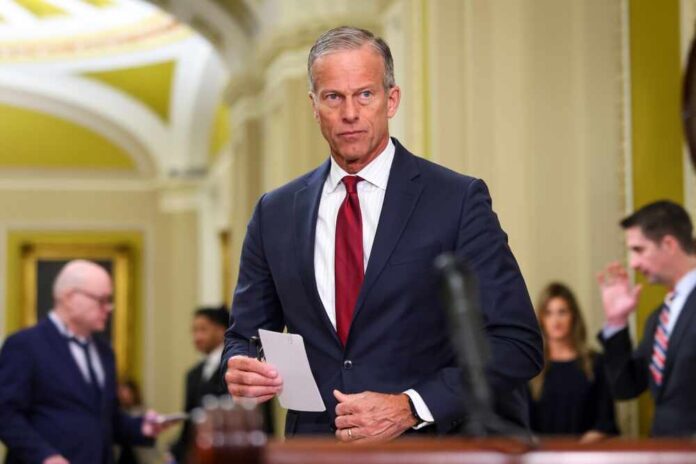
Senate Majority Leader John Thune admits he does not have the 60 votes needed to overcome a Democrat filibuster or the support inside his own party to “nuke” the filibuster for this bill. Thune has repeatedly told reporters that changing Senate rules is “not a realistic option,” even after Trump publicly urged him to fire the Senate parliamentarian who ruled the bill must clear the 60‑vote hurdle. For many conservative voters, that sounds less like leadership and more like surrender, especially when the White House is begging for action.[1][2][4][7]
RINOs, Filibuster Tactics, And Grassroots Anger
Conservative media and activists now accuse Thune and a small band of so‑called “Republicans in name only” of using the filibuster as political cover to kill the bill while pretending they tried everything. Four Republican senators—Susan Collins, Lisa Murkowski, Mitch McConnell, and Thom Tillis—have already voted with Democrats to block cloture on the SAVE America Act, stopping the bill before it even reached a final vote. Critics argue that Thune is carefully avoiding a clean majority vote that would expose which Republicans stand with Trump’s election‑integrity agenda and which side with Democrat talking points about “voter suppression.”[1][6][9]
Reports from closed‑door meetings say some Republican senators told Thune they will never vote for the SAVE America Act simply because they oppose Trump personally, no matter what the bill contains. Thune’s office denies those claims, but the anger back home is real, with the South Dakota Republican Party moving toward a censure over his handling of the bill. Trump allies like Byron Donalds and Jim Banks have blasted the Senate filibuster as the main obstacle to what they call a simple, common‑sense requirement that only citizens vote in federal elections. Their message to Senate Republicans is blunt: if you will not stand for secure elections now, voters will remember in the next primary.[1][2][3]
Supreme Court Ruling Raises Stakes On Mail‑In Ballots
The pressure on Thune increased sharply after the Supreme Court’s 5–4 decision in Watson v. Republican National Committee, which upheld Mississippi’s rule allowing mail‑in ballots to be counted if they are postmarked by Election Day but arrive up to five days later. Justice Amy Coney Barrett’s majority opinion said federal election‑day statutes do not block such grace periods and stressed the case was about interpreting laws, not rewriting the Constitution. Civil‑rights groups cheered the ruling as protecting voters who follow the rules but face postal delays, while conservatives saw it as another opening for ballot harvesting and abuse.[8][14]
Roughly fourteen states plus several territories already let election officials count ballots that arrive after Election Day if they carry an Election Day postmark, and the Court’s ruling effectively blesses that practice nationwide. Supporters say this simply reflects how mail has long worked in America and note that there is little documented proof of widespread mail‑in ballot fraud. But many Republicans argue that when deadlines slide and envelopes stack up for days, it becomes far harder for citizens to trust close results, especially in states that already resist basic voter ID rules. For them, the SAVE America Act is a needed guardrail, not an attack on voting.[11][12][15]
Media Narrative, “Voter Suppression” Claims, And What Comes Next
Major media outlets and legal groups quickly branded the SAVE America Act a “voter suppression” bill, warning it could make voting harder for millions who lack passports or easy access to documents. Organizations like the Brennan Center for Justice and the Campaign Legal Center argue the bill would force many voters to re‑register in person and put new burdens on election offices already stretched thin. They point to studies that find only rare cases of proven non‑citizen voting and say the real risk is keeping eligible Americans from the polls, not stopping fraud that they claim barely exists.[2][4][5][22]
Conservatives respond that these same groups pushed mass mail‑in voting, ballot drop boxes, and speech policing during the 2020 cycle, while treating any talk of fraud as “disinformation.” They note that federal and state officials now openly talk about monitoring and removing online content about elections, which many Trump voters see as a direct threat to free speech and honest debate. With Trump tying his entire legislative agenda to passage of the SAVE America Act, and grassroots Republicans furious at a Senate that seems more worried about Senate customs than voter confidence, the question is simple: will John Thune side with the voters who put Republicans in power, or with a Washington system that many Americans no longer trust?[15][21]
Sources:
[1] Web – (VIDEO) Trump Calls Out Senate RINOs and John Thune for Refusal to …
[2] YouTube – 4 GOP Senators join Dems to block SAVE America Act
[3] Web – SAVE Act, Republicans’ voting overhaul, fails in the Senate – NPR
[4] Web – WATCH: Padilla Leads Charge to Successfully Block Another SAVE …
[5] Web – House Passes New Version of the SAVE Act
[6] Web – How the SAVE Act Threatens the Freedom to Vote
[7] Web – The question everyone is asking: Why hasn’t the Senate passed the …
[8] Web – The SAVE America Act – The White House
[9] Web – Supreme Court Protects Mail Voting and Preserves States’ Authority …
[11] Web – The US Supreme Court ruled 5-4 Monday that states can count mail …
[12] Web – Supreme Court allows states to accept mail ballots after Election …
[14] Web – Table 11: Receipt and Postmark Deadlines for Absentee/Mail Ballots
[15] Web – Supreme Court rules mail-in ballots arriving after Election Day can …
[21] Web – [PDF] THE DYNAMICS OF ELECTORAL INTEGRITY A THREE-ELECTION …
[22] Web – Chapter: 5 Ensuring the Integrity of Elections