

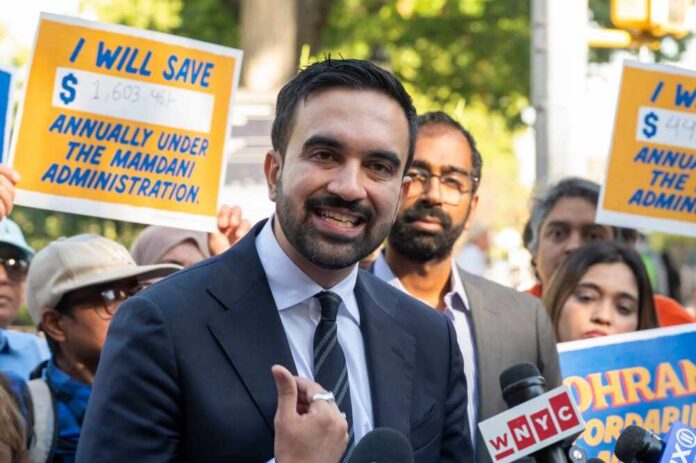
Donald Trump is backing a hard-line push to review and possibly revoke the citizenship of New York City Mayor Zohran Mamdani, putting birthright and naturalized Americans squarely in the political crosshairs.
Story Snapshot
- Trump amplified Michael Savage’s call to deport “hardcore communist bastards” like Mamdani.
- House Republicans want the Justice Department to probe Mamdani’s path to citizenship and possible denaturalization.
- Immigration law experts say stripping citizenship requires hard proof of fraud, which has not surfaced.
- The struggle highlights a bigger fight over loyalty, immigration, and constitutional protections.
Trump backs deportation talk and questions Mamdani’s loyalty
President Donald Trump publicly boosted commentator Michael Savage after Savage urged that “hardcore communist bastards” like New York City Mayor Zohran Mamdani be deported. Savage’s podcast transcript, shared by Trump, argued that many immigrants lack loyalty to the United States and even called for ending birthright citizenship under the Fourteenth Amendment. Trump has also labeled Mamdani a “communist” in repeated remarks, including in television clips where he used the term several times while talking about the mayor’s agenda. These attacks fold Mamdani into a wider debate about whether some immigrant politicians are undermining American values and security.
Trump’s criticism goes beyond name-calling and reaches into policy threats. He has warned that his administration will “watch” Mamdani closely and even suggested arrest if Mamdani follows through on promises to defy federal immigration enforcement. Trump also threatened to withhold federal funds from New York City if Mamdani won the mayoral race, tying city budgets to his view of acceptable political behavior. For many conservative voters worried about lawlessness and radical ideology in big cities, Trump’s stance is a direct answer to fears about leaders who oppose border enforcement and support far-left causes.
Republicans push denaturalization while experts draw legal lines
In Congress, Republicans like Representative Andy Ogles of Tennessee have taken the fight into the legal arena. Ogles sent letters to the Department of Justice asking for an investigation of Mamdani’s naturalization, citing his support for the Holy Land Foundation defendants and his membership in the Democratic Socialists of America as signs of “communist” and “terroristic” alignment. Ogles argues that if Mamdani lied or hid these ties when he became a citizen in 2018, he should be denaturalized and deported. Another Republican, Representative Randy Fine, has urged a sweeping review of naturalizations over three decades, with Mamdani named as a key test case.
Immigration law however sets a high bar for stripping citizenship. Fact-checkers and legal experts point out that the government must show a specific false statement on the citizenship application that actually affected the decision to grant citizenship. Membership in the Democratic Socialists of America is not the same as belonging to a communist party under immigration rules, and by itself is not a bar to becoming a citizen. So far, immigration specialists say they have seen no evidence that Mamdani concealed disqualifying information or engaged in fraud in his paperwork. The Department of Justice has not announced any active case against him, even as Republican letters urge action.
Media reaction, constitutional stakes, and conservative concerns
Mainstream outlets and fact-checkers have largely dismissed the “communist” label for Mamdani and framed the attacks as racially charged or extreme. PolitiFact directly called Trump’s accusation that Mamdani is a communist “false,” stressing the lack of proof. At the same time, some coverage has noted that anti-immigrant rhetoric has surged in recent years but rarely leads to actual denaturalization of elected officials, because of the strict legal standards. This split leaves many conservatives frustrated, seeing media downplay what they view as serious questions about ideology, foreign ties, and loyalty.
Trump’s own interactions with Mamdani add another twist. After Mamdani’s election, Reuters reported that Trump welcomed him warmly at the White House and praised his win, despite earlier harsh rhetoric. Fox News commentators have criticized decisions by Mamdani’s team, such as a planned meeting with Iran’s United Nations ambassador, asking “whose side is he on?” while stopping short of backing calls for deportation. These mixed messages can make it harder for voters to track where tough talk ends and real policy begins, especially when constitutional rights like citizenship and free speech are involved.
Sources:
mediaite.com, politifact.com, facebook.com, truthout.org, mediamatters.org