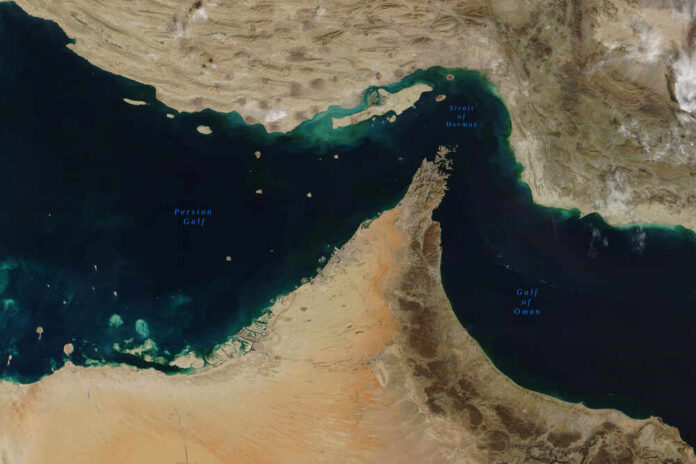
Iran’s effective shutdown of the Strait of Hormuz has turned a critical global trade artery into a hostage situation—and the U.S. Navy is now the only force capable of breaking it.
Quick Take
- Iran has effectively closed the Strait of Hormuz, a chokepoint that carries roughly one-third of global seaborne oil trade, jolting energy and shipping markets.
- Major carriers have halted bookings or ordered ships to shelter, signaling that commercial traffic cannot safely operate under current threats.
- U.S.-Israeli strikes that began Feb. 28, 2026 escalated into a wider regional conflict, with retaliatory attacks spreading across Gulf states.
- Reports describe U.S. Navy offensive operations against Iranian naval assets, echoing past U.S. doctrine for establishing maritime dominance.
Hormuz Becomes a Weapon Against the World Economy
Iran’s moves have effectively closed the Strait of Hormuz, the narrow passage that connects the Persian Gulf to global markets and underpins modern energy logistics. With roughly one-third of seaborne oil trade moving through that corridor, even a short disruption can ripple into fuel prices, shipping delays, and inflation pressure. Iran’s posture is not symbolic: Iranian commanders publicly threatened commercial transit, aiming to stop exports outright.
Commercial shipping reacted like an industry that believes the threat is real and sustained. MSC halted all bookings to the Middle East region, CMA CGM told vessels to seek shelter and suspended Suez transits, and Hapag-Lloyd warned of delays and rerouting across services calling at Gulf ports. Those corporate decisions matter because they reflect risk calculations from insurers, operators, and crews—not political talking points—at a moment when safe passage is collapsing.
How a Regional Strike Campaign Escalated Into a Multi-Country Conflict
The current crisis traces back to rising tensions in mid-2025, then erupted into open conflict on Feb. 28, 2026 with coordinated U.S.-Israeli operations against Iran. Reporting describes waves of strikes on Iranian cities and military infrastructure, including command-and-control, missile, UAV, and radar sites. It also cites a pivotal leadership shock: Iran’s Supreme Leader Ali Khamenei was reportedly killed in Israeli strikes that day.
Iran’s retaliation spread across the Gulf in ways that directly endanger civilians and international commerce. The compiled timeline includes ballistic missile strikes and drone attacks affecting UAE locations such as Port Fujairah and Dubai, and impacts reported in Bahrain, Kuwait, and Iraqi Kurdistan. Also notes damage at Saudi oil infrastructure, and injuries tied to port and vessel incidents. These effects widen the battlefield and complicate any rapid return to normal maritime traffic.
What “Breaking the Blockade” Actually Requires From the U.S. Navy
It points to offensive U.S. naval action against Iranian naval forces, including reports of Iranian warships sunk by U.S.-Israeli strikes. It also draws a historical parallel to Operation Praying Mantis in 1988, when the U.S. Navy fought Iranian forces and asserted control after attacks on shipping. The takeaway is operational, not rhetorical: to reopen Hormuz, the U.S. must suppress Iran’s ability to attack ships, not merely escort them.
Shipping realities underscore why half-measures often fail. It cites growing danger to crews, rising insurance costs, and increased hazard pay—classic signs that the private sector cannot price the risk at normal levels. It also describes vessels holding south of Hormuz, a visible bottleneck that builds economic pressure by the hour. If Washington wants commerce restored, maritime security has to become reliable enough that carriers will resume schedules—not just hopeful enough for headlines.
Negotiations, Uncertainty, and the Stakes for American Families
Diplomacy appears fluid and contradictory in the available reporting. President Trump accepted an Iranian proposal for negotiations with a four-week operational timetable, while other Iranian officials later ruled out talks and Iran’s intelligence ministry denied ceasefire engagement. With key claims moving in different directions, the public should be cautious about assuming a near-term deal. For U.S. households, prolonged disruption risks higher energy costs feeding broader price pressure.
Limited government conservatives generally agree on one basic point: the U.S. cannot allow a hostile regime to decide whether the world’s most important energy corridor stays open. It does not provide a single definitive timeline for reopening Hormuz, and casualty and damage assessments remain uncertain in places. What is clear is that Iran’s threat posture has already altered global shipping behavior, and restoring predictable passage will hinge on sustained U.S. naval capability.
Sources:
Strait of Hormuz Crisis: Iran Conflict Impact on Energy and Business