

A fresh round of MAGA infighting is raising an uncomfortable question for voters: how many “America First” politicians are true believers—and how many are simply reading the polls?
Story Snapshot
- Former Rep. Marjorie Taylor Greene says Rep. Mike Lawler privately mocked and “hated” Donald Trump before later presenting himself as strongly pro-Trump.
- Greene’s claims highlight a broader loyalty-and-authenticity fight inside the GOP during Trump’s second term, even with Republicans controlling Congress.
- Greene’s own break with Trump has escalated, including harsh rhetoric and calls tied to disputes over policy and priorities.
Greene’s claim spotlights the “MAGA label” problem
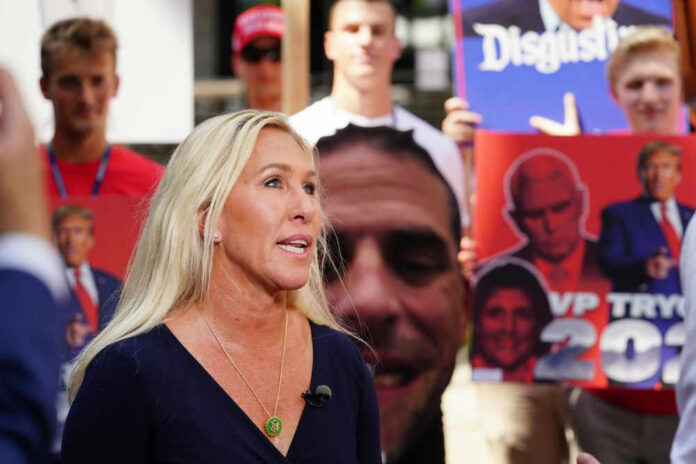
Marjorie Taylor Greene is alleging that Rep. Mike Lawler, a New York Republican, spent years privately ridiculing Donald Trump—then pivoted into a pro-Trump posture once Trump won the 2024 primary and returned to power. Greene said Lawler mocked Trump’s voice and confronted her on the House floor over her Trump support, before later shifting into what she described as “MAGA Mike Lawler.” The accusation centers on political authenticity, not legislation.
The key limitation is verification: the allegation involves private behavior and is presented through Greene’s recounting in an interview setting. It does not include corroborating witnesses, recordings, or a detailed rebuttal from Lawler in the cited materials. That doesn’t make Greene’s claims false, but it does mean readers should treat the “constant mockery” charge as an assertion that would need more sourcing to become a settled fact.
Why this matters when Republicans run Washington
Republicans holding the House, Senate, and White House has not eliminated internal conflict; it has shifted the battleground from party-versus-party to faction-versus-faction. Greene’s attack suggests a suspicion many conservative voters already carry after years of broken promises on spending, border enforcement, and bureaucratic reform: some politicians adopt “MAGA” branding as a career move. For voters who want limited government and accountability, opportunism matters because it often predicts wavering under pressure.
That same skepticism is also shared, in different language, by many Americans on the left who believe politics is dominated by insiders protecting their own power. When Greene frames figures as “acting like a Democrat” against Republican priorities, she is tapping into a wider frustration that Washington incentives reward posturing over results. Whether one blames “globalism,” entrenched agencies, or party machines, the underlying complaint is similar: voters feel governed by self-preservation, not principle.
Greene’s break with Trump complicates the loyalty narrative
The backdrop is messy: Greene was long viewed as a Trump-aligned firebrand, yet multiple reports describe a deteriorating relationship that ended with Greene leaving Congress and publicly criticizing Trump. A CBS News report describes a major change in their relationship and notes Greene’s historically high alignment with Trump’s positions before the rupture. Other reporting details Greene firing back after Trump labeled her a “traitor,” adding to a cycle where personal feuds consume oxygen that would otherwise go to policy fights.
For conservatives focused on governance outcomes—lower inflation pressure, energy affordability, border control, and restrained federal power—high-profile personality clashes can feel like a costly distraction. At the same time, factional fights can reveal where genuine disagreements lie, especially if they expose lobbying influence or shifting “brand” politics. The hard part for voters is separating legitimate policy dissent from attention-driven escalation, because both can look similar in clip-driven media.
What to watch next: proof, pushback, and political incentives
Three practical questions now matter more than the insults. First, does Lawler respond directly, and can any colleagues substantiate Greene’s account of pre-2024 mockery? Second, does Greene provide additional detail—names, dates, or settings—that would make the claim testable? Third, will Republican leadership treat this as noise or as a real test of caucus trust ahead of midterms, when unity often determines whether priorities like spending restraint and oversight actually move.
Marjorie Taylor Greene Claims MAGA Congressman ‘Hates Donald Trump’ and ‘Made Fun of Him Constantly’ https://t.co/vZe8bIgIhq
— Mediaite (@Mediaite) April 30, 2026
In the meantime, the episode is a reminder that “draining the swamp” is not only about confronting Democrats or federal agencies; it also requires scrutiny of Republicans who shift positions when the political wind changes. If voters want less theater and more results, they will likely demand receipts—verifiable facts, consistent votes, and measurable follow-through—rather than just new labels. On that standard, the next developments will matter more than the soundbites.
Sources:
Marjorie Taylor Greene Claims MAGA Congressman ‘Hates Donald Trump’ and ‘Made Fun of Him Constantly’
Marjorie Taylor Greene Trump relationship change – 60 Minutes
Marjorie Taylor Greene fires back at Trump who called her a ‘traitor’