
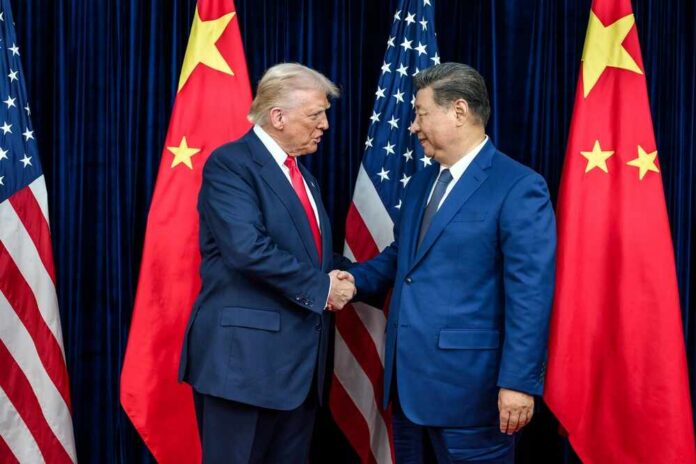
Beijing just threw Washington’s economic sanctions playbook into the shredder, ordering Chinese companies to openly defy American penalties on oil refineries just weeks before President Trump and Xi Jinping sit down for what could be the most consequential diplomatic meeting in years.
Story Snapshot
- China’s Commerce Ministry issued a formal injunction on May 2, 2026, directing all Chinese firms to ignore US sanctions on five “teapot” refineries accused of purchasing Iranian oil
- The targeted refineries, including Hengli Petrochemical and four Shandong-based processors, collectively handle roughly 25% of China’s total refining capacity
- Beijing explicitly declared the US sanctions a violation of international law, prohibiting recognition or compliance within Chinese territory
- The defiant move comes just weeks before a scheduled Trump-Xi summit, setting an aggressive tone for negotiations between the world’s two largest economies
- Industry experts estimate China’s blocking maneuver could restore $100-500 million monthly in Iranian oil revenue that US sanctions sought to eliminate
When Energy Security Meets Geopolitical Chess
The refineries at the center of this diplomatic firestorm aren’t household names, but their impact on global energy flows is substantial. Teapot refineries, the industry term for China’s independent processors concentrated in Shandong and Hebei provinces, emerged after deregulation in the 2010s and now process approximately 3.5 million barrels per day. These smaller operators survive on razor-thin margins by purchasing heavily discounted crude oil from sanctioned suppliers like Iran, Venezuela, and Russia, often paying five to ten dollars per barrel below benchmark Brent prices.
The five refineries named in China’s injunction face US asset freezes and transaction prohibitions under Executive Orders 13846 and 13902, measures originally designed to choke off Tehran’s nuclear program funding. Hengli Petrochemical, sanctioned in April 2026 for billions in Iranian oil purchases, stands as the largest target. The four Shandong-based facilities, Jincheng Petrochemical Group, Hebei Xinhai Chemical Group, Shouguang Luqing Petrochemical, and Shandong Shengxing Chemical, received their penalties throughout 2025 as the Trump administration revived its “maximum pressure” campaign against Iran.
The Blocking Statute That Changes Everything
China’s Ministry of Commerce didn’t merely lodge a diplomatic complaint. The injunction, published through state media outlet Xinhua, represents the first explicit deployment of Beijing’s updated 2026 blocking statute against US energy sanctions. The ministry’s statement attacked American measures as unauthorized by the United Nations and incompatible with basic norms governing international relations. Any Chinese entity or individual now faces potential domestic penalties for complying with the US restrictions, effectively creating a legal shield around the targeted refineries.
Ahead Of Trump-Xi Summit, Beijing Tells Chinese Firms To Ignore U.S. Sanctions On "Teapot" Refineries https://t.co/kwrxxKPBkF
— zerohedge (@zerohedge) May 2, 2026
This marks a significant escalation from China’s previous approach. Between 2019 and 2022, Washington blacklisted more than ten teapot refineries, including Shandong Dongming, yet Beijing limited its response to verbal objections and behind-the-scenes evasion through ship-to-ship transfers and dark fleet tankers. The 2023 application of similar blocking measures against US semiconductor restrictions demonstrated China’s willingness to formalize its defiance, but applying the same framework to energy sanctions crosses a new threshold in the US-China economic confrontation.
Summit Timing Sends Unmistakable Message
Diplomatic coincidences rarely exist at this level of international relations. China’s announcement arrived on May 2, 2026, positioned precisely in the run-up to the late-May Trump-Xi summit scheduled to take place in China. Beijing’s timing signals that energy sovereignty and resistance to what it characterizes as American “long-arm jurisdiction” constitute non-negotiable positions entering the negotiations. Xi Jinping’s government appears intent on demonstrating strength rather than seeking accommodation before the leaders meet.
The pre-summit posture carries risks for both sides. Trump’s Treasury Department estimates Chinese purchases have generated more than ten billion dollars for Iran’s regime, funding that US policy explicitly seeks to eliminate. The administration now confronts a choice: escalate with additional secondary sanctions targeting Chinese banks and insurers that facilitate the oil trade, or accept diminished sanction effectiveness as the price of maintaining broader diplomatic engagement. Either path complicates the summit agenda, which already includes contentious issues around trade imbalances, intellectual property, and technology restrictions.
Economic Realities Behind Political Theater
Strip away the diplomatic rhetoric, and the teapot refineries face brutal economics that make Iranian crude nearly indispensable. China’s overall refining utilization hovers around 80 percent amid weak domestic fuel demand, forcing independent processors to operate at negative margins of one to two dollars per barrel. Iranian discounts provide the difference between survival and bankruptcy for facilities that lack the scale and integration advantages of state-owned giants like Sinopec and PetroChina.
The sanctions disrupted payment channels and shipping logistics, forcing some teapots to rebrand their products to obscure Iranian origins. China imports an estimated 1.5 million barrels per day of Iranian oil through covert channels, with teapots dependent on Iranian crude for more than 30 percent of their feedstock according to shipping analytics firm Vortexa. Beijing’s injunction essentially formalizes what was already occurring in the shadows, transforming illegal evasion into state-protected commerce.
Sanction Erosion and Dollar Alternatives
The broader pattern reveals systematic erosion of American sanction power when major economies choose non-compliance. Historical data from similar confrontations suggests compliance rates drop 50 to 70 percent after China implements formal blocking measures. The teapot injunction accelerates trends toward yuan-denominated oil trading and financial systems operating outside dollar-clearing networks. Iran receives desperately needed revenue, China secures discounted energy supplies, and Washington watches its primary non-military coercion tool lose effectiveness.
Industry analysts at S&P Global characterize the current sanctions as increasingly symbolic, with Chinese state banks absorbing compliance costs to maintain strategic oil flows. The approach encourages targeted countries to deepen alternative payment arrangements and supply relationships, potentially spurring greater teapot purchases from Russia and Venezuela beyond existing Iranian volumes. Each sanction workaround that Beijing institutionalizes makes the next evasion easier and the next American penalty less credible.
What the Summit Could Reveal
The late-May meeting between Trump and Xi will test whether either leader blinks first on energy sanctions. Trump could demand Chinese cooperation on Iran enforcement as a condition for trade concessions, potentially linking teapot compliance to tariff negotiations or technology transfer agreements. Xi’s pre-summit defiance suggests Beijing views energy security and sovereignty principles as beyond bargaining range, making accommodation unlikely without substantial American concessions elsewhere.
The alternative scenario involves mutual recognition that sanctions and counter-sanctions have reached a strategic stalemate, with both sides agreeing to tacit coexistence in exchange for progress on other fronts. Such an outcome would represent a quiet American retreat from maximum pressure tactics, acknowledging that unilateral sanctions cannot override the economic imperatives of the world’s largest energy consumer. Either way, five refineries in Shandong and Dalian now stand at the intersection of great power competition, energy markets, and the limits of economic statecraft.
Sources:
China’s Commerce Ministry blocks US sanctions against five refineries – Economic Times
China rejects US sanctions on refineries over Iran oil links – Channel News Asia
China rejects US sanctions on refineries over Iran oil links – Turkiye Today
China rejects US sanctions on refineries over Iran oil links – Dawn