

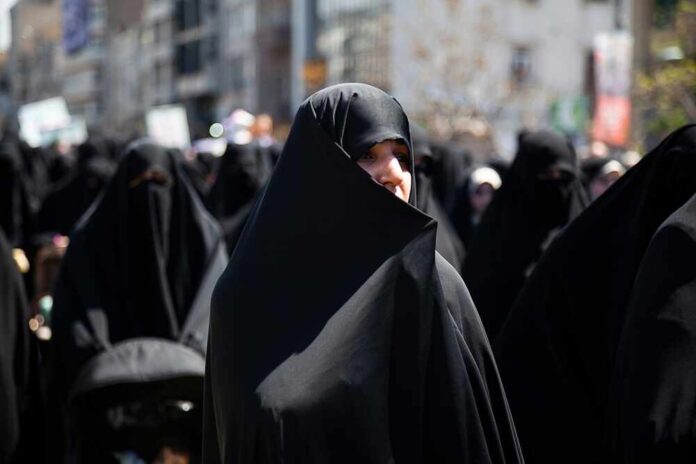
Iran’s theocratic regime has weaponized so-called “family protection” laws to impose death penalties, flogging, and devastating fines on women who dare defy compulsory veiling mandates, exposing the brutal reality of religious totalitarianism that American patriots fought to prevent through our Constitution’s protections of individual liberty.
Story Snapshot
- Iranian authorities approved a 74-article law imposing death penalty, prison terms up to 15 years, and fines reaching $22,000 for women defying mandatory hijab rules
- The law grants impunity to vigilantes and security forces while targeting businesses that serve non-compliant women with closures and asset seizures
- Despite pausing formal implementation in December 2024 due to international backlash, regime forces sealed over 50 businesses and deployed facial recognition surveillance systems throughout 2025
- The draconian measures emerged after the 2022 “Woman Life Freedom” uprising sparked by Jina Mahsa Amini’s death in custody for “improper hijab”
Regime Codifies Oppression Following Nationwide Protests
The Iranian judiciary drafted the Law on Protecting the Family through the Promotion of the Culture of Chastity and Hijab in May 2023, responding directly to the nationwide protests that erupted after 22-year-old Jina Mahsa Amini died in morality police custody. Parliament approved the 74-article bill in September 2023 with a three-year pilot program, and the Guardian Council rubber-stamped it in September 2024. Parliament Speaker Mohammad Ghalibaf announced enforcement would begin December 13, 2024, though state media reported a temporary pause the following day amid mounting international pressure and domestic resistance.
Brutal Penalties Target Women and Businesses
The legislation represents a quantum leap beyond previous enforcement mechanisms under Islamic Penal Code Article 638. Women face death sentences for activism deemed “corruption on earth” when linked to foreign entities, alongside flogging, prison terms extending to 15 years, and fines reaching $22,000. Travel bans and restrictions on education and employment compound the punishment. Businesses serving non-compliant women face forced closures, asset seizures, and permanent license revocations. The regime expanded enforcement authority to the Islamic Revolutionary Guard Corps Intelligence, Ministry of Intelligence, Basij militia, and regular police forces while providing legal immunity to vigilantes who assault women for dress code violations.
Surveillance State Replaces Overt Policing Tactics
Iranian authorities shifted tactics throughout 2025 rather than formally implementing the paused law. Security forces sealed over 50 businesses in Tehran, Shiraz, and other cities between late June and early October 2025 for serving women without proper hijab. The regime deployed facial recognition technology in public transportation and urban spaces, with Filterwatch documenting Isfahan’s comprehensive surveillance systems in April 2025. Undercover agents infiltrate public spaces to identify violators, while prosecutors continue targeting celebrities and issuing traffic citations for non-compliance. This technological approach allows the theocracy to maintain oppression while avoiding the optics of morality police beating women in the streets.
International Condemnation Highlights Constitutional Freedoms
Human rights organizations uniformly condemned the law’s constitutional violations. Amnesty International’s Diana Eltahawy characterized the legislation as making women’s lives “intolerable” following the uprising. The Center for Human Rights in Iran’s Bahar Ghandehari noted authorities changed tactics but maintained their war against women’s freedom. Human Rights Watch’s 2025 World Report documented intensified enforcement through business closures and prosecutions, while the UN Office of the High Commissioner for Human Rights reported escalating surveillance and systematic repression in March 2025. Iran has refused to accede to the Convention on the Elimination of All Forms of Discrimination Against Women for 47 years, maintaining structural discrimination rooted in the 1979 Islamic Revolution’s theocratic framework.
The hospitality and retail sectors suffered crippling economic damage from forced closures, while women face daily harassment that restricts their mobility, employment opportunities, and educational access. The regime’s weaponization of technology for social control demonstrates how totalitarian governments exploit modern tools to suppress individual liberty. This stands as a stark reminder why America’s Founders enshrined protections against government overreach in our Constitution, recognizing that concentrated state power inevitably targets the most vulnerable. The Iranian women’s courageous resistance against religious tyranny deserves recognition from all who value freedom over forced compliance to authoritarian mandates dressed up as moral legislation.
Sources:
Iran’s New Tactics to Crush Hijab Resistance: Business Raids and Surveillance – Iran Human Rights
Iran – World Report 2025 – Human Rights Watch
Women’s Rights in Iran: 47 Years of Structural Discrimination – Iran HRM
Iran: Government continues systematic repression and escalates surveillance – OHCHR