
A federal judge has stopped Virginia from enforcing its new ban on Immigration and Customs Enforcement agents wearing masks, handing the Trump administration an early constitutional win against a blue-state crackdown on federal immigration enforcement.
Story Snapshot
- A federal judge issued a preliminary order blocking Virginia’s mask ban for federal officers just before it took effect.
- The Trump Department of Justice (DOJ) argues Virginia cannot criminalize how federal agents dress or identify themselves on the job under the Supremacy Clause.
- The blocked law would have banned masks and imposed new identification rules on federal officers, including Immigration and Customs Enforcement agents.
- Governor Abigail Spanberger and Virginia leaders claim the law is about “transparency,” while federal officials say it risks doxing and violence against agents.
Judge Blocks Virginia’s Mask Ban Before It Hits Federal Agents
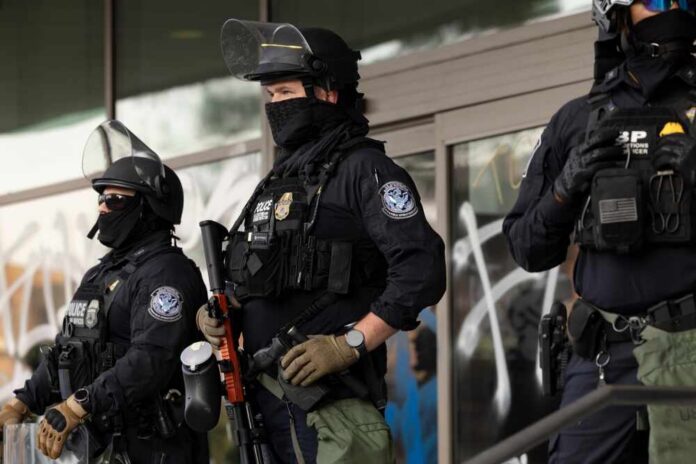
A federal judge stepped in on the eve of enforcement and blocked Virginia’s new mask ban from applying to federal law enforcement officers, including Immigration and Customs Enforcement agents. The law, signed by Democratic Governor Abigail Spanberger, would have made it a crime for federal officers to wear facial coverings that hide their faces while performing official duties in the Commonwealth, with only narrow exceptions. It also tied mask rules to new identification demands, exposing agents’ names or identifiers during immigration operations.
The Department of Justice, under President Trump, had just filed suit arguing Virginia’s scheme is an unconstitutional attempt to regulate federal officers. The complaint says Virginia’s law violates the Supremacy Clause by directly dictating how federal agents carry out enforcement, including the choice to wear masks and how they display identification. DOJ lawyers warned that, without court action, federal agents could face criminal charges simply for following federal safety policies while doing their jobs inside Virginia.
Virginia’s “Transparency” Push Versus Federal Safety Concerns
Governor Spanberger and her allies framed the mask ban as a push for transparency and public trust, claiming masked officers “undercut basic expectations of accountability” and “sow fear and confusion” on American streets. Her executive order also moved to restrict how federal immigration officers use state property, barring them from staging operations at courthouses, schools, or polling places and demanding warrants before entering many state facilities. Supporters argued Virginians deserve to see who is enforcing the law in their communities and to be able to report misconduct with clear identifiers.
The Trump DOJ pushed back, saying this rhetoric hides a direct attack on federal immigration enforcement. In its filing, DOJ warned that exposing agents’ identities during heated immigration operations invites doxing, harassment, and even violence, especially after years of rising threats against federal officers. The complaint also argued that Virginia’s law “functionally” shuts down cooperative immigration programs between local police and federal Immigration and Customs Enforcement, known as 287(g) agreements, by putting local partners under conflicting state rules. DOJ asked the court to block both the mask ban and identification provisions before the July 1 effective date.
Supremacy Clause Fight Echoes Other Blue-State Mask Bans
This clash in Virginia is part of a growing pattern: blue states pass laws aimed at federal immigration officers, and federal courts step in to protect the Constitution. California became the first state to ban most law enforcement, including federal immigration officers, from covering their faces, while also forcing non‑uniformed officers to display agency and badge information. The Trump administration sued, arguing California’s mask ban and identification rules discriminated against federal officers and exceeded state authority over federal operations.
A federal court granted a preliminary injunction against California’s mask ban for federal agents, finding the law illegally targeted federal officers while exempting state law enforcement. The judge allowed a separate identification requirement to stand, but stressed that states cannot directly regulate how federal agents perform their lawful duties. Legal analysts say these rulings rest on the Supremacy Clause and the “intergovernmental immunity” doctrine, which bars states from singling out federal officers for special burdens or controlling their operational methods.
What Comes Next for Immigration Enforcement and State Power
The judge’s order blocking Virginia’s law is only preliminary, so the case will now move into deeper court hearings and possible appeals. Virginia Attorney General Jay Jones has already pushed back publicly, saying his office will fight to defend what he calls safe communities and transparent enforcement. Media outlets and activists on the left are framing the lawsuit as “Trump’s DOJ versus Governor Spanberger,” turning a constitutional question into another partisan brawl.
Judge blocks Virginia ICE mask ban on eve of implementation @joedodson16 https://t.co/uIO5jeTDot
— Courthouse News (@CourthouseNews) July 1, 2026
For conservatives, the stakes are clear: if states can criminalize federal officers for wearing masks or using standard identification practices, they can choke off immigration enforcement whenever politics demand it. The Virginia case will test how far blue states can go in the name of “transparency” before they run into the hard wall of the Supremacy Clause and federal authority. As more states like New York adopt similar bans and restrictions, the outcome here will shape whether Immigration and Customs Enforcement agents can safely do their jobs without state governments tying their hands.
Sources:
foxnews.com, justice.gov, wjla.com, youtube.com, thehill.com, facebook.com, washingtonpost.com, reddit.com, nccriminallaw.sog.unc.edu, nysenate.gov