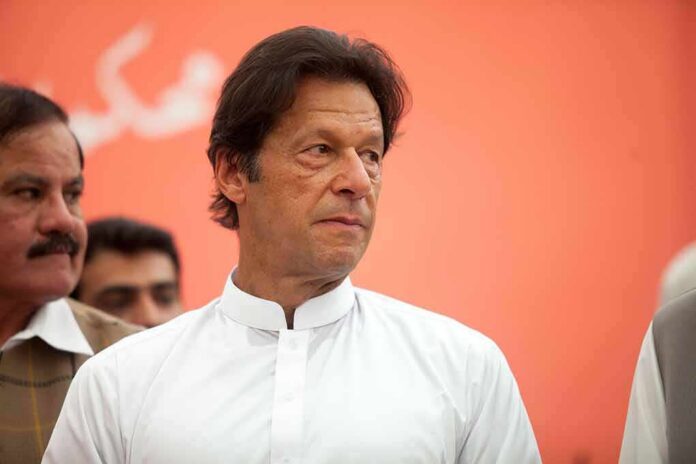
Pakistan flooded its capital with police and cut mobile service as Imran Khan’s supporters launched a days-long march to Islamabad to demand his release.
Story Highlights
- Thousands joined a Pakistan Tehreek-e-Insaf march from Khyber Pakhtunkhwa toward Islamabad to free Imran Khan.
- Authorities locked down the capital and deployed heavy security, with mobile service curbed in parts of the country.
- Named party leaders, including Khyber Pakhtunkhwa’s chief minister, helped lead convoys toward D-Chowk.
- Reports describe multiple convoys and road closures as the government sought to contain the rally.
March Launches From Pakistan’s Northwest With Clear Demands
Reuters reported that thousands of supporters of jailed former Prime Minister Imran Khan began a long march to Islamabad on Sunday from Khyber Pakhtunkhwa, organized by Khan’s Pakistan Tehreek-e-Insaf party to demand his release. Al Jazeera likewise described a planned party action after talks with authorities failed. Voice of America reported that Khan called for supporters to gather at D-Chowk in Islamabad as part of the push for his release and political rights.
Local outlets tracked the convoys moving along the corridor from Peshawar toward the capital. Reporting identified multiple vehicles and crowds moving in stages toward Islamabad. Aaj TV said Khyber Pakhtunkhwa Chief Minister Ali Amin Gandapur joined the convoy that aimed for D-Chowk, a central protest site in the capital. This matched other coverage showing organized movement over several days, with supporters concentrating along main approach roads into Islamabad.
Security Lockdown And Communications Limits Surround The Capital
Authorities treated the march as a capital-security event. Reuters said thousands of police and paramilitary units were deployed in and around Islamabad, with barriers set and routes restricted. Voice of America reported that the government locked down key areas and partially suspended mobile internet services as the convoys advanced. Al Jazeera reported in late September that officials had already sealed roads leading to the capital in anticipation of the protests.
These steps fit a pattern seen in Pakistan’s recent protest cycles. When opposition groups head for Islamabad, the state often responds with show-of-force deployments, road closures, and communications restrictions. Analysts and prior reporting describe this recurring clash between street pressure and containment tactics as part of a deeper political stalemate that pushes rallies into the streets rather than into institutions.
Named Leaders, Routes, And The Scope Of Participation
Coverage highlighted specific leaders and routes to confirm this was a coordinated party effort. Aaj TV named Khyber Pakhtunkhwa Chief Minister Ali Amin Gandapur and noted the convoy’s target of D-Chowk, underscoring direct party oversight of the march. Arab News described convoys departing Peshawar and heading for the capital, adding detail on timing and movement through Punjab. These accounts establish planning, leadership, and direction, not a spontaneous crowd surge.
PTI began its long march toward #Islamabad after talks with the government ended in deadlock. KP Chief Minister Sohail Afridi is leading the convoy, with the party reiterating its demands linked to Imran Khan.#PTI #ImranKhan https://t.co/O4KNvinJ9W
— Asia Brief (@AsiaBrief_) October 6, 2026
Estimates of turnout remained broad and used the word “thousands,” which is common in fast-moving protest coverage. That said, the government’s heavy security posture and communications curbs suggest officials expected large crowds and prolonged tension. The core facts remain uncontested across major outlets: organized convoys moved from Khyber Pakhtunkhwa toward Islamabad to demand Imran Khan’s release, and the state responded with lockdown measures to limit escalation.
Sources:
youtube.com, reuters.com, abcnews.com, tribune.com.pk, arabnews.com, bbc.com, amp.dw.com, arabnews.pk, english.aaj.tv